






















Data Mesh vs Data Fabric: How to Choose in 2026
Share this article
What is the difference between data mesh and data fabric?
Permalink to “What is the difference between data mesh and data fabric?”Data mesh is an operating model that decentralizes data ownership to domain teams, who publish data as products. Data fabric is an integration architecture that uses metadata and automation to connect data across systems through a unified access layer, without centralizing all data in one place.
When one central team controls all of an organization’s data, it becomes a traffic jam. Every request, every report, every analysis passes through the same group. Data mesh solves this by decentralizing ownership, allowing business domains to manage data as products. Data fabric takes the opposite path, using automation to integrate data across systems from a unified layer.
Your choice depends on how your company is structured, how mature your technology is, and whether you need team-level independence or unified control. Mesh changes how people work with data. Fabric changes how technology connects to it.
Here is how the two approaches compare at a glance:
| Aspect | Data mesh | Data fabric |
|---|---|---|
| Core approach | Each business team owns its own data | One platform connects all data using automation |
| Primary focus | Changing how people work | Changing the technology layer |
| Data ownership | Spread across business teams | Managed centrally |
| Implementation timeline | 6–12 months (requires cultural change) | 4–8 weeks (mostly technical setup) |
| Best for | Large organizations with independent teams | Companies using multiple cloud providers that need one view of all data |
| Governance model | Each team governs its own data within shared guidelines | Central rules applied everywhere |
| Scalability | Grows by adding new domains | Grows through automation |
| Key technology | Data products, self-service tools, APIs (connectors between systems) | AI, machine learning, automated data tracking |
Data mesh vs. Data fabric: What is the primary difference between them?
Permalink to “Data mesh vs. Data fabric: What is the primary difference between them?”Data mesh decentralizes ownership to domain teams who publish data as products. Data fabric centralizes integration through automated connectivity across systems. Mesh changes operating responsibilities while fabric changes infrastructure. Both solve distributed data complexity but from opposite directions.
What is a data mesh?
Permalink to “What is a data mesh?”Data mesh is a decentralized data architecture and operating model where domain teams own and serve data as products, within shared governance guardrails. The goal is to remove bottlenecks and make the people closest to the data responsible for maintaining it.
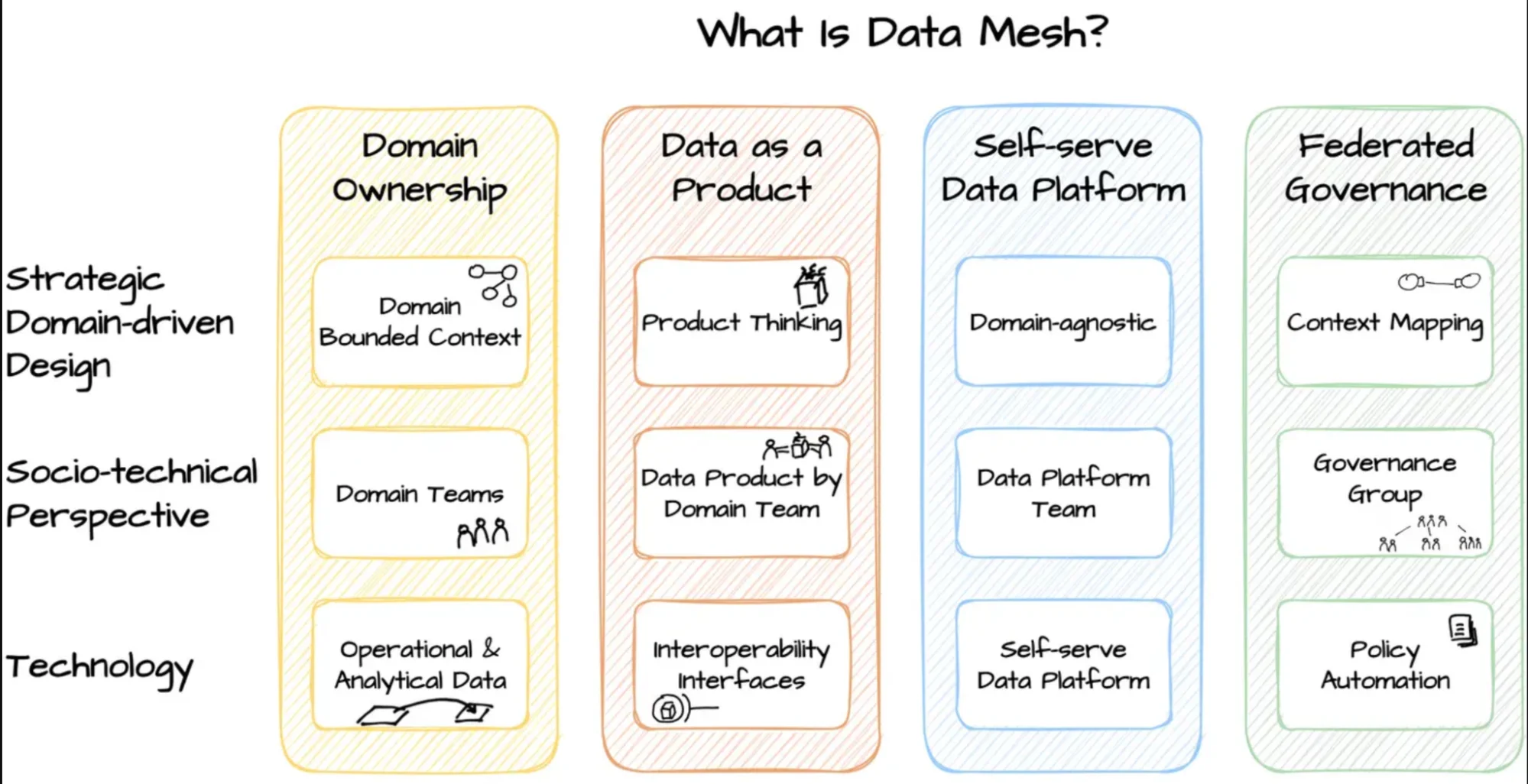
Data mesh gives a solution architecture for the specific goal of building business-focused data products.
What is data fabric?
Permalink to “What is data fabric?”Data fabric is a metadata‑driven integration architecture that uses active metadata and automation to connect data across systems through a unified, virtualized layer. Instead of moving data between platforms, it sits on top of existing tools and links them intelligently. The goal is to give everyone a single, consistent way to find and access data, with the same security and quality rules applied everywhere.
Where mesh reorganizes teams and workflows, fabric adds smart connectivity on top of what already exists.
The clearest distinction is about responsibility. Data mesh distributes responsibility across business teams, while data fabric centralizes intelligence on a single platform.
What are the key benefits of data mesh?
Permalink to “What are the key benefits of data mesh?”Data mesh lets business teams own their data. Teams get to move independently, set quality standards that match their specific needs, and respond more quickly to changes. With data ownership comes accountability. As a result, data quality improves because these teams understand the context best.
Here are the main benefits:
- Each team owns its data: Every business unit manages its data from start to finish, treating it as a product with documentation, quality checks, and easy discoverability. This removes the bottleneck where a single central team tries to handle all the organization’s data requests.
- No more waiting on the central team: As organizations grow, central data teams get overwhelmed. McKinsey found that a large mining company built new data solutions 7x faster after adopting data mesh, a process that previously took months. When business teams manage their own data pipelines, the central team can focus on the underlying platform rather than fielding every request.
- Faster experimentation: Business teams try new data sources and analyses without waiting for central approval. This freedom accelerates how quickly teams turn raw data into useful insights.
- Better collaboration across departments: Data mesh encourages each team to publish its data so others can easily find and use it. Instead of data locked inside one team’s tools, published data products create a shared library.
- Quality standards that match the data: Each team sets quality rules relevant to its own data. A healthcare team applies different checks than a supply chain team. These targeted standards produce better results than one-size-fits-all rules applied across every dataset.
What are the key benefits of data fabric?
Permalink to “What are the key benefits of data fabric?”Data fabric gives organizations a single, automated way to access data across all their systems. It enforces the same security, access, and quality rules everywhere. This simplifies analysis, shows data lineage, and reduces complexity.
Key benefits include:
-
One view of all your data: Data fabric connects everything through a single layer, without physically moving data from one system to another. For supply chain leaders, Gartner notes that data fabrics reduce the time and cost of connecting data sources while improving AI-driven decision-making.
-
Consistent rules everywhere: When you manage data centrally, access controls, privacy protections, and compliance rules apply consistently across all systems. If a file contains personal information, protections are automatically activated, regardless of where the data is stored.
-
Easier analysis across systems: Users search and analyze data across different platforms without manually exporting and importing files. This eliminates duplicate data and lowers the risk of working with outdated information.
-
Clear tracking of data sources: Data fabric automatically tracks how data moves from its original source through every change and transformation until it is used.
-
Lower complexity for everyone: The fabric layer hides the underlying systems’ technical complexity, giving both technical and non-technical users a single, consistent way to find and use data.
Data mesh vs data fabric: What are the tradeoffs?
Permalink to “Data mesh vs data fabric: What are the tradeoffs?”Data mesh risks inconsistent practices across teams and requires significant coordination. Data fabric provides consistency and central control, but can create a single point of failure and slow down individual teams.
Both carry real costs.
Forrester analyst Henry Goetz estimated that setting up a single data mesh domain can cost up to $50 million.
Every architecture choice comes with tradeoffs, and this one is no different. Goetz labeled the shared governance model in data mesh as its “weak link”. That $50 million figure shows why understanding the full picture matters before committing.
| Approach | Strengths | Challenges |
|---|---|---|
| Data mesh | - Removes the central bottleneck - Business teams respond faster - Promotes ownership - Grows naturally as new teams join |
- Requires a big shift in company culture - Risks uneven data quality across teams - Needs experienced teams with technical skills - High coordination effort |
| Data fabric | - Enforces the same rules everywhere - Automates data connections - Simplifies access across systems - Faster to deploy initially |
- Can become a single point of failure - The central team may become the new bottleneck - May slow individual teams’ progress - Needs strong central technical talent |
A 2024 survey by Wavestone and NewVantage Partners found that 80% of respondents said the biggest barrier to becoming data-driven is people, culture, and process, not technology.
Data mesh demands major organizational change, while data fabric requires less cultural disruption but more technical sophistication.
A TDWI study found that 35% of respondents cited governance concerns as a barrier, and another 35% said the approach requires too big a change, both technically and organizationally. In regulated industries such as healthcare, banking, telecom, and insurance, confidence in mesh drops from 55% to 35%.
Data fabric has its own hurdles. Its AI faces technical limitations in connecting data across systems. It requires strong technical talent.
Which factors should guide your decision between data mesh and data fabric?
Permalink to “Which factors should guide your decision between data mesh and data fabric?”Five factors matter most: how your company is structured, how complex your data is, how skilled your teams are, how strict your compliance needs are, and how fast you need results. Data mesh fits large, decentralized companies with independent teams. Data fabric suits organizations with central IT that need a single way to access data across many systems. Consider running a small pilot before committing fully.
Start by looking at how your company works today. Here are the five factors to weigh:
1. How is your company structured?
Permalink to “1. How is your company structured?”McKinsey research shows that banks spend 6–12% of their annual tech budget on data, and picking the right architecture can cut implementation time in half and lower costs by 20%.
- If your business units already operate independently with strong technical skills, data mesh fits naturally.
- If a central IT team manages your technology and sets the rules, data fabric builds on that foundation.
2. How complex is your data?
Permalink to “2. How complex is your data?”- If different parts of your business handle very different types of data (e.g., patient records vs. supply chain logistics), mesh lets each team handle data in its own way.
- If your main challenge is that data lives across multiple systems and cloud providers need to communicate, Fabric’s automated connections are more practical.
3. How skilled are your teams?
Permalink to “3. How skilled are your teams?”- Data mesh requires teams across the company to build, manage, and maintain data products. It takes time and training to develop.
- A data fabric centralizes technical expertise within a single team, reducing the number of specialists needed across business departments. However, the central team itself requires advanced skills.
4. How strict are your compliance requirements?
Permalink to “4. How strict are your compliance requirements?”- If your teams collaborate well and share accountability, a distributed governance approach works well. Go for data mesh.
- If regulations require the same rules to be applied identically everywhere, with complete audit records, centralized governance is a safer choice. Go with data fabric.
A survey by Precisely and Drexel University found data governance concerns surging to 54% in 2024, up from 27% in 2023, with 62% citing it as their top challenge for AI projects.
5. How fast do you need results?
Permalink to “5. How fast do you need results?”- Data mesh typically takes 6 to 12 months because it requires changing culture and building new habits. However, starting small is the key to success. If you have high-pain use cases, like customer-facing reporting, embed an analytics engineer to create a template for the rest of the company.
- Data fabric goes live in four to eight weeks, supported by a strong central team. It focuses on technical setup rather than organizational change.
Here’s a quick overview to help you make an informed decision:
| Factor | Choose data mesh if | Choose data fabric if |
|---|---|---|
| Company structure | Business units operate independently with strong expertise | Central IT manages infrastructure and sets standards |
| Data complexity | Different teams handle very different types of data | Data lives across many systems that need to be connected |
| Team skills | Teams across the company have technical data skills | Most technical expertise sits in one central team |
| Compliance needs | Teams collaborate well and can share accountability for rules | Regulations require identical enforcement and complete audit trails |
| Speed to results | You can invest 6–12 months in cultural and technical change | You need results in 4–8 weeks with minimal organizational disruption |
Can data mesh and data fabric work together?
Permalink to “Can data mesh and data fabric work together?”Most companies in 2026 use both. Data fabric provides the automated technology layer that connects systems, while data mesh defines which teams own which data and how they maintain it.
The combined approach scales analytics responsibly while giving individual teams the freedom to act. It also helps maintain consistent standards where needed.
Gartner’s 2025 Data & Analytics Summit included a session titled “R.I.P. Data Fabric vs. Mesh Debate”. It’s a signal that these two are complementary. Data mesh organizes data into a decentralized team within business units, and a data fabric ensures interoperability.
PwC also enforces this messaging. Instead of picking one, leading organizations make use of fabric for technology and connectivity. Data mesh handles the team ownership and accountability part.
How do data mesh and data fabric approaches to governance differ?
Permalink to “How do data mesh and data fabric approaches to governance differ?”Governance refers to the rules and processes that govern how data is accessed, used, and protected. In data mesh, each business team enforces these rules for its own data, within a shared set of guidelines. In a data fabric, one central team creates and enforces the same rules across all systems. Mesh needs strong teamwork across groups to stay consistent, while fabric needs a well-resourced central team to avoid becoming a bottleneck.
How you manage rules and access controls determines whether either approach succeeds or fails at scale. The model you pick shapes how policies get created, enforced, and updated.
Governance in data mesh
Permalink to “Governance in data mesh”In data mesh, governance works through a shared-responsibility model. A central group sets the overall standards (the “guardrails”), while individual teams enforce them on their own data. In practice, teams formalize these agreements through data contracts that define quality standards, usage terms, and SLAs between producers and consumers.
Gartner’s 2024 survey found that 64% of organizations have spread their data teams across business units, and 51% use some form of shared governance.
This works when teams have the skills and discipline to maintain quality, security, and compliance on their own. Strong communication becomes essential so teams don’t drift apart in how they handle data.
Governance in data fabric
Permalink to “Governance in data fabric”With data fabric, governance is automated and centralized. The platform tracks data across all systems and enforces rules automatically. When a dataset contains sensitive information, access restrictions and privacy protections kick in. You get to create and manage rules from a single platform.
This reduces the risk of inconsistency across the organization, but it puts all decision-making power in one group. If that group is slow or under-resourced, it becomes the new bottleneck.
The hybrid approach combines both strengths. A central team sets the overall standards while individual teams decide how to apply those standards within their own context. For companies that need both control and speed, this blended model offers the strongest foundation.
How does each approach handle data quality?
Permalink to “How does each approach handle data quality?”In data mesh, each team sets quality standards for its own data, based on specific needs. Mesh produces quality that fits each team’s context. In data fabric, quality monitoring runs centrally across all systems, enforcing the same rules everywhere. Fabric produces consistency across the organization. The tradeoff is relevance vs. uniformity.
Quality ownership is one of the sharpest differences between the two.
How data mesh handles quality
Permalink to “How data mesh handles quality”In data mesh, each team defines what good data looks like for its specific use. A product analytics team applies different checks than a financial reporting team. This targeted approach produces better results because the people setting the rules understand the meaning and context of the data.
The risk is fragmentation. When 20 teams each define quality differently, analysis that pulls data from multiple teams can break down. One team’s definition of “active customer” may differ from another’s. Without coordination, these gaps grow as the organization scales. Gartner estimates that poor data quality costs organizations an average of $12.9 million per year.
How data fabric handles quality
Permalink to “How data fabric handles quality”Data fabric uses centralized quality monitoring. Automated rules scan data across all systems, flagging issues and enforcing consistent standards everywhere.
This benefits organizations that require all departments to use identical definitions. However, centralized rules may miss nuances specific to a team. Moreover, updating them requires going through the central group, which may not prioritize one team’s needs over another’s.
The most effective approach combines both. Individual teams own the quality for their specific data, while a central layer monitors consistency across the organization and flags conflicts between how different teams define the same terms.
This keeps accountability at the team level while maintaining the shared standards required by company-wide analysis and AI projects.
How does Atlan support both data mesh and data fabric architectures?
Permalink to “How does Atlan support both data mesh and data fabric architectures?”Data mesh needs tools that help teams create and share their data. Data fabric needs a platform that automatically connects data across systems. Most traditional tools only support one of these approaches, limiting your options as needs evolve.
Atlan is a data and AI control plane that acts as the central metadata layer for both data mesh and data fabric architectures, connecting 100+ systems and powering governance, lineage, and discovery in one place.
- For data mesh Atlan provides a marketplace where teams publish their data products with quality scores and usage tracking, organized by business domain. Each data product includes a scorecard based on the DATSIS principles (discoverable, addressable, trustworthy, secure, interoperable, self-describing), giving consumers a clear signal of whether a product meets their needs. Teams formalize ownership with data contracts—versioned, enforceable agreements that define schemas, quality expectations, SLAs, and usage rules between producers and consumers, all embedded directly in Atlan’s metadata layer.
- For data fabric, Atlan automatically finds and connects data across 100+ systems, tracks how data moves from source to report, and enforces rules centrally.
- Atlan supports hybrid setups in which teams own their data while the organization maintains a unified view.
Autodesk adopted data mesh after its central data team could no longer keep up with demand. Using Atlan and Snowflake, 60 domain teams now publish and manage their own data products, powering 45 self‑service use cases that a single central team could never have handled alone.
Aliaxis, a manufacturer operating in 40+ countries, uses Atlan as the unified metadata layer that connects Snowflake, dbt, and Power BI into a single, searchable data estate. Automated, end‑to‑end lineage helped Aliaxis reduce root‑cause and impact‑analysis effort by ~95%, going from a full day of manual investigation to about an hour.
A single glossary bridges global and regional definitions, giving both local teams and central leadership consistent visibility into what data exists. Read the full Aliaxis story.
In practice, Atlan provides the metadata and governance fabric underneath your mesh domains—so data mesh defines who owns what, and Atlan’s fabric‑like control plane connects everything, enforces policies, and keeps data products discoverable and trustworthy.
See how Atlan supports your data architecture. See the platform in action.
What are some FAQs about data mesh vs. data fabric?
Permalink to “What are some FAQs about data mesh vs. data fabric?”1. What is the primary difference between data mesh and data fabric?
Permalink to “1. What is the primary difference between data mesh and data fabric?”Data mesh gives individual business teams ownership of their data, treating it as a product they maintain and share. Data fabric connects all of an organization’s data through a single automated platform. Mesh changes how people and teams are organized. Fabric changes the technology layer. Both solve the problem of managing data at scale, but from opposite starting points.
2. Is data mesh the same as data fabric?
Permalink to “2. Is data mesh the same as data fabric?”Data mesh and data fabric are not the same. Data mesh decentralizes ownership to domain teams, while fabric centralizes integration and governance through an automated platform layer.
3. What are the benefits of implementing data mesh?
Permalink to “3. What are the benefits of implementing data mesh?”Data mesh gives business teams direct control over their data, removes the bottleneck of one central team handling everything, and aligns data management with business needs. Teams scale independently, experiment faster, and respond to changes without waiting in a queue.
4. What are the benefits of implementing a data fabric?
Permalink to “4. What are the benefits of implementing a data fabric?”Data fabric provides a single automated way to access data across all systems, regardless of where it lives. It enforces the same security and quality rules across platforms, tracks how data changes over time, and simplifies the technical complexity of managing multiple platforms.
5. Which approach is better for my organization?
Permalink to “5. Which approach is better for my organization?”Data mesh works best for large, decentralized companies where teams operate independently and have technical skills. Data fabric fits organizations that need a single way to access data across many different systems with centralized rules. Many companies use both, with fabric handling the technology connections and mesh handling team-level ownership.
6. How long does each approach take to implement?
Permalink to “6. How long does each approach take to implement?”Data mesh typically takes 6 to 12 months because it requires changing how teams are organized and how they work. With a strong central technical team, data fabric can go live in four to eight weeks, since it focuses on connecting systems rather than restructuring the organization.
7. Can data mesh and data fabric be used together?
Permalink to “7. Can data mesh and data fabric be used together?”Yes, most large enterprises use data mesh and data fabric together. Data fabric provides the automated connectivity and unified metadata layer, while data mesh defines which teams own which data products and how they maintain quality.
8. What role does metadata play in each approach?
Permalink to “8. What role does metadata play in each approach?”Data fabric relies on metadata heavily for automated tracking, connection mapping, and rule enforcement across systems. In data mesh, metadata helps teams document their data products and make data easy to find. Both need strong metadata management, but use it for different purposes.
9. Which industries benefit most from data mesh vs data fabric?
Permalink to “9. Which industries benefit most from data mesh vs data fabric?”Financial services and large enterprises with complex structures benefit from data mesh’s team-level ownership. Healthcare and manufacturing organizations with data spread across multiple cloud providers benefit from the data fabric’s ability to connect everything. Technology companies often use both.
10. How does Atlan support data mesh implementations?
Permalink to “10. How does Atlan support data mesh implementations?”Atlan provides a marketplace where business teams publish their data products with quality scores and usage tracking. Autodesk uses Atlan to manage 60 business teams with full visibility into who uses each data product.
Which data architecture will drive your organization forward in 2026?
Permalink to “Which data architecture will drive your organization forward in 2026?”Data mesh and data fabric solve the same problem from opposite ends. Your company structure and technology needs should guide the choice. Most companies find that using both works better than picking one.
The trend in 2026 points to hybrid setups. With 61% of organizations rethinking how they manage data because of AI, the architecture you choose needs to support tomorrow’s AI requirements.
Companies that treat data as a strategic asset already see 2–3x greater returns on key metrics, according to Deloitte’s 2025 Tech Value Survey. Yet only 6% of enterprise AI leaders say their data setup is fully AI-ready. This gap is an opportunity.
Evaluate how Atlan supports both data mesh and data fabric. Book a demo
Data mesh vs. data fabric: Related reads
Permalink to “Data mesh vs. data fabric: Related reads”- What is Data Mesh: Architecture Examples, Case Studies, The Role of Metadata, and More
- Data Mesh Architecture: Core Principles, Components, and Why You Need It?
- Data Catalog: Does Your Business Really Need One?
- Data Mesh Setup and Implementation - An Ultimate Guide
- Data Mesh Principles: Top 4 Fundamentals and Architecture
- Snowflake Data Mesh: Step-by-Step Setup Guide, with Detailed Notes on Scaling and Maintenance
- Data Mesh and Data Lake: Understanding Use Cases & Reasons to Deploy
- What is Data Fabric: Definition, Components, Benefits & Use Cases
- Data Fabric vs. Data Virtualization: Overview, Comparison, and Differences
- Data Catalog for Data Fabric: 5 Essential Features to Consider
Share this article