





















Gartner Data Catalog Market Guide 2026: What Buyers Need to Know

Gartner Data Catalog Research: Quick Facts
Permalink to “Gartner Data Catalog Research: Quick Facts”| What | Details |
|---|---|
| Primary Reports | Magic Quadrant (vendor ranking), Market Guide (category overview), Peer Insights (verified reviews) |
| Last MQ Published | November 19, 2025 (first since 2020) |
| Vendors Evaluated | 15 metadata management platforms |
| Key Shift | Augmented catalogs → Metadata orchestration platforms |
| AI Readiness Focus | Active metadata, two-way sync, API-first architecture |
| Leaders Named | Atlan, Alation, Informatica, IBM, Collibra |
| Best For | Enterprise catalog buyers, vendor comparison, business case building |
The return of Magic Quadrant for Metadata Solutions is a market validation moment. It puts metadata at the foundation of AI readiness and modern data strategy. Gartner sees the market moving from augmented data catalogs to metadata-anywhere orchestration platforms. Metadata becomes accessible throughout the stack, enabling technology.
Active metadata management remains a highlight of Gartner’s research. The emphasis is on continuously monitoring systems in real-time to automate discovery, governance, and quality signals.
What is Gartner, and why do organizations use it for catalog selection?
Gartner is a technology research and advisory firm. Enterprises rely on it to compare vendors, verify product claims, and lower the risk of bad platform choices.
No single report covers everything. Gartner publishes several formats, each with a different angle:
- Magic Quadrant (MQ): Ranks vendors as Leaders, Challengers, Visionaries, or Niche Players based on vision and execution.
- Market Guide: Covers where a market is headed and what features matter most.
- Peer Insights: Verified reviews and ratings from users who run these tools in production.
- Hype Cycle: Maps how mature a technology is and when it will be ready for real use.
Together, these give you a practical view of the metadata and data catalog space.
How does Gartner help you pick the right data catalog for your enterprise?
Permalink to “How does Gartner help you pick the right data catalog for your enterprise?”Gartner uses several research formats to help you pick the right data catalog. Instead of one report, you get several. The Magic Quadrant covers vendor comparison. Market Guides add market context, and Peer Insights brings real-world feedback. Together, they cut the risk of costly platform mistakes.
A wrong choice can cost $500K+ in wasted spending, 12 to 18 months of failed rollout, and lost credibility. Gartner’s analysts mitigate this risk through in-depth product analysis and direct customer interviews. They check vendor claims independently. You get expert reviews of real performance, not marketing copy. That clarity helps you spot the gap between what a vendor says and what they deliver.
Each stage of your selection needs a different type of input. A Market Guide shows where the market is headed. The Hype Cycle fills in how ready a technology is. Together, these help you pick a platform that fits your full data strategy.
| Format | Purpose | Best for |
|---|---|---|
| Magic Quadrant | Vendor positioning by vision and execution | Shortlisting vendors |
| Market Guide | Market direction, trends, and key vendors | Deciding whether to invest in a category |
| Peer Insights | Verified customer reviews and ratings | Checking vendor claims against real experiences |
| Hype Cycle | Technology readiness and timeline estimates | Knowing when a technology is production-ready |
Gartner research also helps you build a strong business case.
Without a metadata management approach, enterprises spend up to 40% more on data management. The Magic Quadrant narrows your vendor list from there. Peer Insights adds honest customer feedback on support, setup, and long-term value.
What does Gartner focus on in modern data catalog research?
Permalink to “What does Gartner focus on in modern data catalog research?”Gartner changed what it looks for in 2025. Active metadata, AI readiness, and “anywhere” architecture now sit at the top. Static cataloging carries far less weight. The 2025 MQ for Metadata Management says the shift goes “from augmented data catalogs to metadata ‘anywhere’ orchestration platforms.”
Gartner research reflects how quickly the category is changing and what enterprises should prioritize when evaluating solutions:
AI-driven evolution
Permalink to “AI-driven evolution”Metadata management has outgrown traditional augmented catalogs. Broader orchestration platforms now lead the way. Production AI needs metadata wherever it is needed, not locked inside one tool.
Scattered data becomes useful intelligence as a result.
Active over passive metadata
Permalink to “Active over passive metadata”Static documentation no longer works. Modern platforms automate discovery, data governance, and quality signals in real time. Gartner expects two-way metadata flows, with insights moving across your full data stack. Active systems trigger policies and fine-tune operations based on how data is used.
Open and flexible architecture
Permalink to “Open and flexible architecture”Open APIs are now table stakes. Without them, metadata gets trapped between BI tools, data platforms, and collaboration software. A flexible design lets your platform adapt to new AI agents and data products as they come.
User experience and access
Permalink to “User experience and access”Data catalogs aren’t only for engineers anymore. Gartner checks how easily business users can find, understand, and trust data on their own. Simple self-service leads to higher adoption across technical and non-technical teams alike.
How Gartner structures vendor evaluation
Permalink to “How Gartner structures vendor evaluation”Gartner does not publish a standalone “Data Catalog” Magic Quadrant. It reviews catalog features across reports for Metadata Management, Data & Analytics Governance, and Active Metadata. Catalogs now form part of larger platforms, and this wider scope reflects that shift.
| Gartner Data Catalog Research Format | What It Looks At | How It Helps Buyers |
|---|---|---|
| Gartner Magic Quadrant | How vendors perform based on vision and execution in the related data catalog and metadata markets | Helps teams compare vendors and understand market leaders |
| Gartner Market Guide | Market trends, technology direction, and key vendors in the data catalog space | Gives buyers a practical overview of the market and solution types |
| Gartner Peer Insights | Verified customer reviews covering usability, integration, and governance capabilities | Adds real-world feedback to support vendor shortlisting |
| Gartner Hype Cycle | The maturity and adoption stage of data catalog and data intelligence technologies | Helps organizations judge when to adopt new capabilities |
| Gartner Cool Vendors | Innovative vendors bringing new ideas to data catalog and governance workflows | Highlights emerging solutions worth watching |
| Gartner Vendor Ratings | Overall assessment of vendor strength, product strategy, and execution | Supports informed long-term vendor evaluation |
There is no dedicated “Data Catalog” MQ.
Gartner sees cataloging as one piece of a bigger puzzle. It reviews catalog features inside the MQ for Metadata Management Solutions, which returned in 2025. The MQ for Data & Analytics Governance Platforms covers the rest.
This lets you evaluate how a tool handles the full data lifecycle, including data lineage and active orchestration, rather than just cataloging.
1. Gartner Magic Quadrant for metadata management 2025
Permalink to “1. Gartner Magic Quadrant for metadata management 2025”What’s changed in Gartner’s 2025 Magic Quadrant for Metadata Management?
Permalink to “What’s changed in Gartner’s 2025 Magic Quadrant for Metadata Management?”Gartner reintroduced its Magic Quadrant for Metadata Management in November 2025 after a five-year pause, naming 15 vendors, including Atlan. The market evolved from augmented data catalogs to metadata orchestration platforms during the gap, with AI readiness becoming the primary selection criterion.
Fifteen vendors made it into the report. Leaders include Atlan, Alation, Informatica, IBM, and Collibra. For a side-by-side breakdown, see the comparison.
Between 2020 and 2025, the market was shifting fast. Gartner folded metadata features into broader governance research during that time. Then, generative AI took off, and a dedicated report became necessary again. Organizations cannot scale AI safely without governed, high-quality metadata. Gartner saw this gap clearly.
Metadata evolution from the MQ pause in 2020 to the 2025 return:
| Aspect | 2020 focus | 2025 focus |
|---|---|---|
| Primary use case | Data cataloging | Metadata orchestration |
| AI emphasis | ML features | AI readiness |
| Architecture | Augmented catalogs | “Anywhere” platforms |
| Key strength | ML-powered discovery | Active metadata + APIs |
Data catalogs have moved from passive inventory tools to metadata “anywhere” orchestration platforms. These systems carry context, quality signals, and governance rules wherever your data travels. They connect your entire data stack.
A key finding in the 2025 research: production AI needs mature metadata to work. Manual tagging no longer cuts it. By 2027, Gartner expects active metadata adoption to grow by more than 70% across data, analytics, and AI. Teams will spend less time on documentation and more on AI-driven results.
When picking Leaders, Gartner looked at how well vendors handle complex, spread-out environments. The review focused on:
- Market shift: Technology moved from static catalogs to dynamic orchestration platforms.
- Active metadata: Gartner expects adoption to rise sharply by 2027, driving automation across data operations.
- AI foundation: Metadata readiness is now a must-have for production-grade AI.
- What Gartner measured: Open APIs, range of features, and fast adoption across technical and non-technical users.
Atlan recognized as a Leader
Permalink to “Atlan recognized as a Leader”Gartner named Atlan a Leader in its 2025 Magic Quadrant for Metadata Management Solutions. The recognition comes down to one core strength: Atlan connects metadata from across an enterprise and makes it usable for both people and AI.
- Atlan runs on a metadata lakehouse architecture, which is a single layer that pulls context from every connected system into one place. The design pays off in adoption speed. More than 90 percent of non-technical users are active within 90 days, and DIY connectors let teams plug in their own tools without waiting on engineering.
- Atlan has a 4.6-star rating on Gartner Peer Insights. Companies like Mastercard, General Motors, and Nasdaq already rely on Atlan as the metadata foundation behind their AI governance and analytics.
Gartner Market Guide for data catalogs
Permalink to “Gartner Market Guide for data catalogs”Gartner Market Guides outline the risks and benefits of emerging trends. Questions like “What do we miss if we skip data catalog tools?” drive each report. Rather than ranking vendors, they focus on market direction and key players.
Market Guides and Magic Quadrants serve different goals. A Market Guide helps you decide whether to invest in a technology at all. It covers readiness, new features, and the risks of waiting. Once you commit, the Magic Quadrant helps you pick which vendor to go with.
Use Market Guides when building your business case. They give you context to justify the budget, estimate ROI, and show what happens if you delay.
For perspective: Poor data quality costs organizations $12.9 million per year on average. Putting these numbers next to the value of modern metadata makes a strong case.
Attending Gartner Summit Orlando? Don't miss the sessions that matter most to you
Build Personalized AgendaMarket Guide vs. Magic Quadrant
Permalink to “Market Guide vs. Magic Quadrant”| Aspect | Market Guide | Magic Quadrant |
|---|---|---|
| Purpose | Market understanding | Vendor selection |
| Focus | Trends and direction | Competitive positioning |
| Output | Investment decision | Vendor shortlist |
| Update frequency | As market shifts | Annual (when active) |
What is active metadata management according to Gartner?
Permalink to “What is active metadata management according to Gartner?”Active metadata management lets metadata drive actions and automate workflows. Passive documentation is no longer enough. Gartner’s 2021 Market Guide described active metadata as a new type of feature that spans many data management areas. The core idea: pull metadata from many sources and make it usable in the tools where work happens.
Passive metadata is like a static map. It shows where data lives but needs manual updates. Nothing happens on its own. Catalogs built this way go stale fast. Active metadata changes the game. Systems get monitored in real time. Responses fire across the stack without waiting for someone to step in.
What does this look like day-to-day? Smart suggestions surface the right datasets based on past use. Broken pipelines are flagged and fixed automatically. The moment sensitive data appears, governance rules kick in. Metadata stops being a list and starts being an engine.
This matters for AI readiness. Production AI depends on high-quality metadata.
Gartner predicts active metadata can cut the time to deliver new data assets by up to 70% by 2027. Teams then move from manual documentation to strategic work. Humans and AI agents both get the current context at all times.
Below are some key features of active metadata:
What Gartner emphasizes
Permalink to “What Gartner emphasizes”Gartner positions augmented data catalogs as systems that actively assist users and AI, not static inventories. Core focus areas include:
- ML driven automation
- Comprehensive metadata coverage
- Business user accessibility
- Open API architecture
Core evaluation themes
Permalink to “Core evaluation themes”ML augmented automation
Automates discovery, search, recommendations, quality checks, and governance tagging to reduce manual effort at scale.
Unified metadata inventory
Brings technical, business, operational, governance, and social metadata into a single source of context.
Business friendly experience
Translates technical metadata into intuitive, self service workflows for non technical users enabling true data democratization.
Open and extensible design
Modern and enables bidirectional metadata flow across tools through open APIs and native integrations.
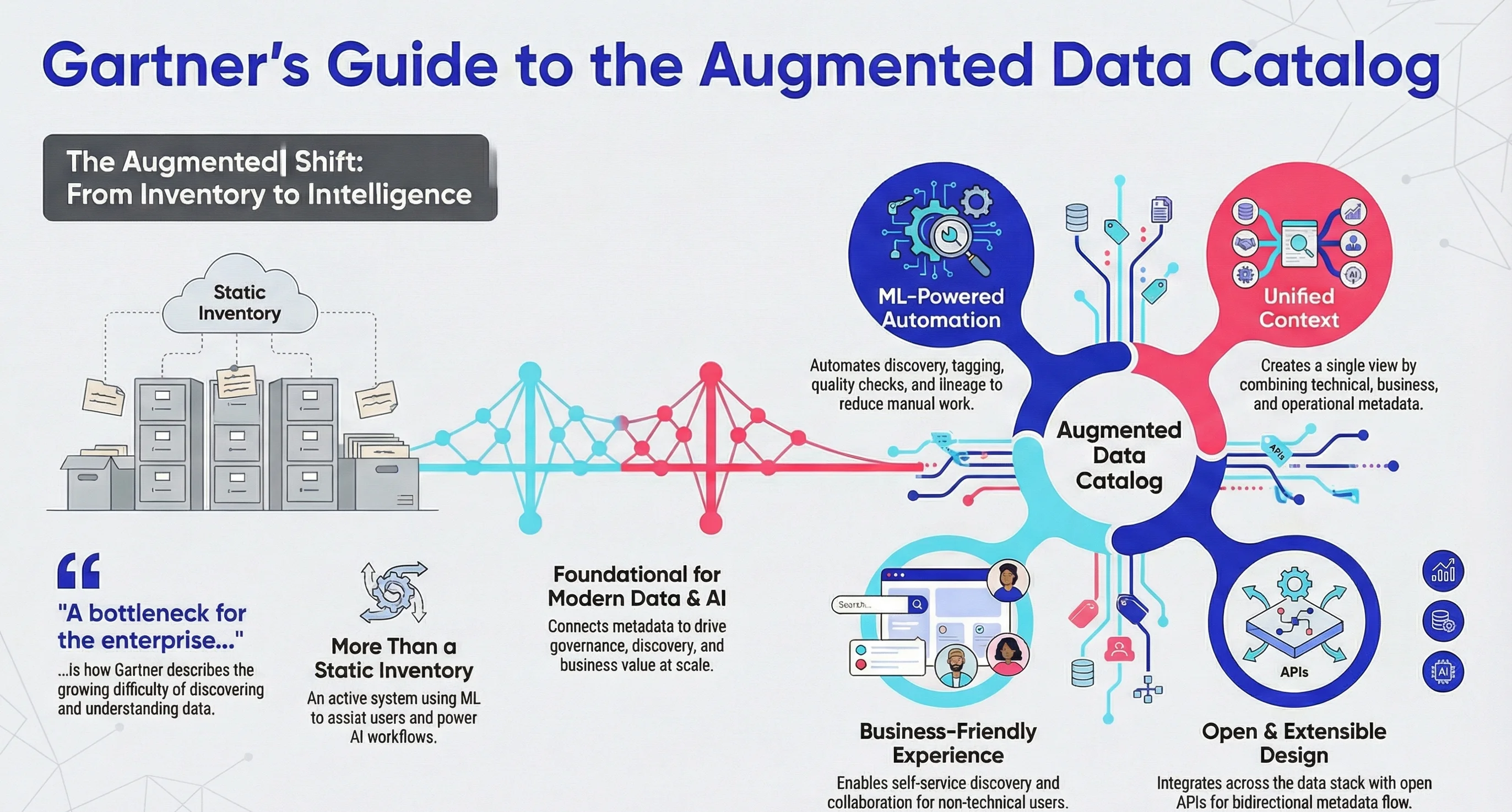
Gartner Market Guide | Augmented Data Catalog. Source: Atlan.
Key components of augmented data catalogs
Permalink to “Key components of augmented data catalogs”-
Automated discovery and scanning
Continuously crawls data sources and pipelines to keep metadata current.
-
Trust and quality signals
Surfaces profiling, freshness, and reliability indicators for faster decision making.
-
Embedded collaboration
Enables in context ratings, comments, and usage signals around data assets.
-
Governance and compliance
Automates lineage, sensitive data classification, and policy enforcement.
Together, these components define augmented data catalogs as active metadata platforms that support analytics, governance, and AI at enterprise scale.
Gartner Market Guide: Active Metadata Management
Permalink to “Gartner Market Guide: Active Metadata Management”In July 2021, Gartner introduced the Market Guide for Active Metadata Management to signal a major shift in how metadata platforms should operate. Traditional solutions were largely passive. They collected and documented metadata but stopped short of driving action. These tools were limited in automation, weak in ML support, and often closed systems with minimal API extensibility.
Gartner defined active metadata management as an emerging capability spanning multiple data management markets. For data and analytics leaders, this evolution is not incremental. It is transformational for every data enabling technology, especially as AI adoption accelerates.
Gartner recommendations for active metadata
Permalink to “Gartner recommendations for active metadata”Gartner outlines three core principles that define active metadata platforms.
Openness as a requirement
Closed metadata standards create silos and limit reuse. Gartner emphasizes open standards and APIs so metadata can move freely across the data stack and power downstream tools and workflows.
Automation beyond cataloging
Active metadata platforms go past discovery and lineage. They automate workflows, trigger policies, generate recommendations, and optimize data quality, orchestration, and cost based on real usage and context.
Collaboration through unified metadata
When metadata is unified, teams can collaborate through shared context. Ratings, tags, conversations, and certifications turn metadata into institutional knowledge rather than isolated documentation
- Smart recommendations: Surfaces the best data assets for a project based on usage patterns.
- Workflow optimization: Adjusts data pipelines on its own to increase performance or cut costs.
- Automated governance: Enforces data privacy and security rules in real time across all connected systems.
- Continuous discovery: Scans and indexes new data the moment it enters the system.
- Two-way flow: Shares metadata insights back and forth between tools in your data stack.
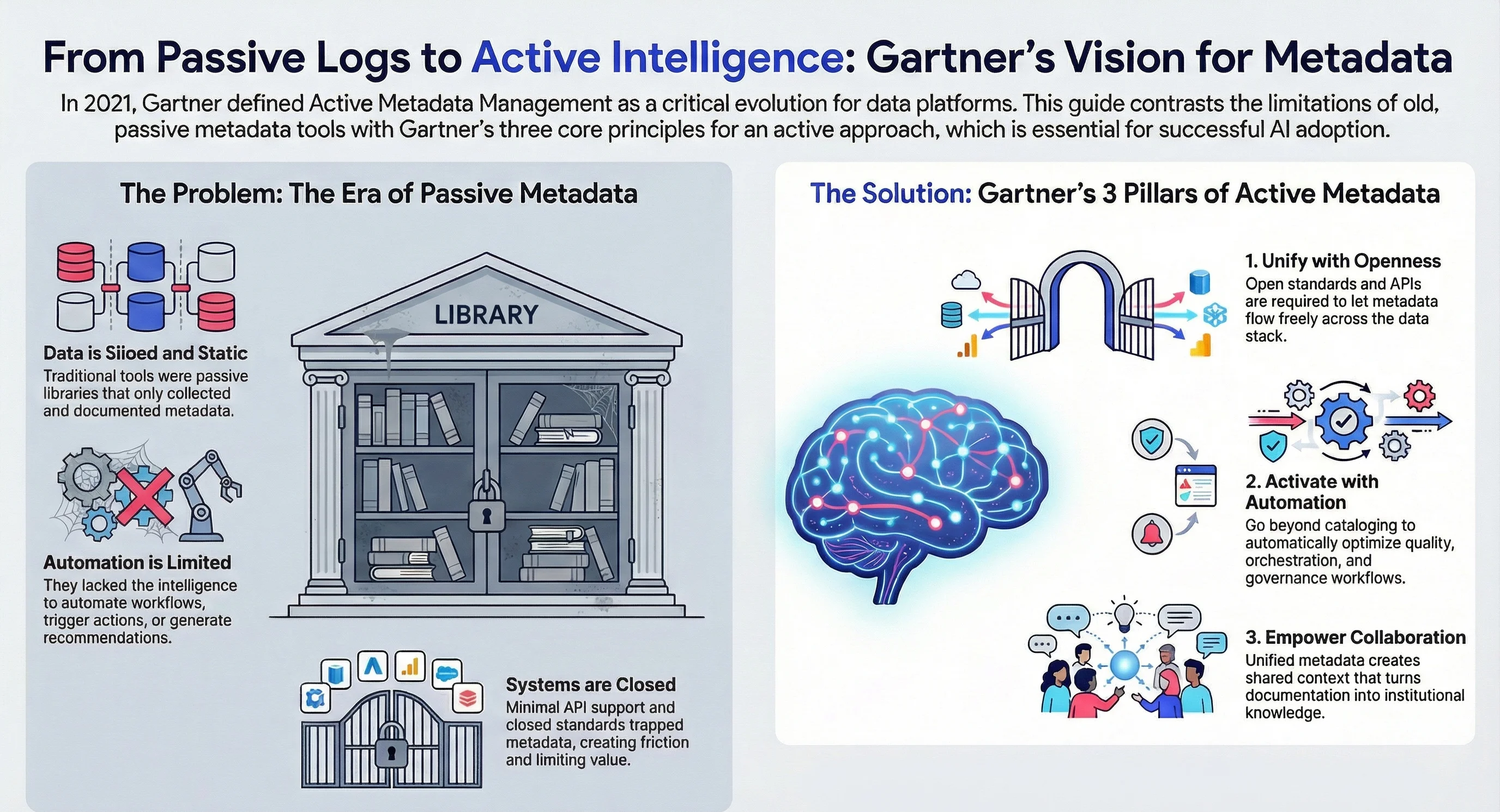
Gartner Market Guide: Active Metadata Management. Source: Atlan.
Gartner outlines three core principles that define active metadata platforms.
| Principles | What It Means | Why It Matters |
|---|---|---|
| Openness as a requirement | Open standards and APIs let metadata move across your data stack | Prevents silos and supports seamless integration |
| Automation beyond cataloging | Metadata triggers workflows, policy enforcement, and alerts in real time | Reduces manual work and keeps governance active |
| Collaboration through unified metadata | Teams share tags, ratings, and context in one metadata layer | Builds trust and improves cross-team decisions |
How augmented data catalogs evolved into metadata orchestration platforms?
Permalink to “How augmented data catalogs evolved into metadata orchestration platforms?”Augmented data catalog tools used machine learning to automate tagging and discovery. They helped, but they stayed passive. Orchestration platforms work differently: they push metadata everywhere, across BI tools, data platforms, governance systems, and AI workflows. This reflects a growing need for metadata as a strategic asset, not an inventory list.
Gartner Market Guide | Augmented Data Catalog. Source: Atlan.
For a while, augmented catalogs set the bar. ML handled profiling, sorting, and tagging, which significantly reduced manual effort. But at their core, these tools served as a central inventory for people to check. Metadata sat locked inside the catalog. You had to leave your main tools to find what you needed.
Those limits pushed the market forward. Gartner states that “metadata management is shifting from traditional or augmented data catalogs toward broader metadata orchestration platforms.” Modern platforms spread governed context, such as quality scores and security tags, across your entire data stack. The shift goes from static inventory to a live control layer.
Open APIs and “metadata anywhere” delivery round out the picture. Metadata flows freely between BI tools, data warehouses, and AI agents in real time. No passive storage holds it back. Production AI needs enforced context at every step, and orchestration ensures it.
Augmented catalog vs. orchestration platform
Permalink to “Augmented catalog vs. orchestration platform”| Feature | Augmented catalogs | Orchestration platforms |
|---|---|---|
| Metadata flow | One-way (into catalog) | Two-way (to and from systems) |
| How it activates | Manual via UI | Automated via APIs |
| Scope | Catalog-focused | System-wide |
| AI support | Discovery help | Production AI-based |
Gartner Peer Insights for data catalog validation
Permalink to “Gartner Peer Insights for data catalog validation”Gartner Peer Insights provides honest customer reviews to verify vendor claims. Search by geography, company size, industry, or rating to find cases like yours. These reviews surface problems and results that formal analyst reports often miss.
The platform hosts a big library of verified reviews across hundreds of tech areas. You get a candid look at support quality and whether a vendor lives up to what they promised.
For data catalogs, check the Gartner Metadata Management Solutions and Active Metadata Management sections.
Filters let you cut thousands of reviews down to match your setup. Sort by company size, industry, or how the tool was deployed. This helps you spot hidden costs or setup hurdles that similar teams faced. You see how a catalog works in your world, not in some market average.
What to look for in peer reviews:
- Adoption numbers: How quickly did non-technical users start using the tool? Some platforms report 90%+ adoption within 90 days.
- Support quality: Do customers say the vendor acts as a partner, or do they flag slow case resolution?
- Time-to-value: Did users go live in weeks or months? Speed keeps project momentum.
- Setup complexity: Watch for warnings about needing outside help or heavy effort to get started.
Real stories from real customers: How organizations maximize data value with Atlan
Permalink to “Real stories from real customers: How organizations maximize data value with Atlan”Organizations across industries use Atlan to power their metadata foundation for AI governance and context-aware analytics. The platform’s recognition in multiple Gartner reports reflects its proven ability to deliver business outcomes.

From Hours to Minutes: How Aliaxis Reduced Effort on Root Cause Analysis by almost 95%
"A data product owner told me it used to take at least an hour to find the source of a column or a problem, then find a fix for it, each time there was a change. With Atlan, it's a matter of minutes. They can go there and quickly get a report."
Data Governance Team
Aliaxis
🎧 Listen to AI-generated podcast: How Aliaxis Reduced Effort on Root Cause Analysis

From Weeks to Hours: How Tide Automated GDPR Compliance
"We needed to tag personally identifiable information across our entire data estate to strengthen GDPR compliance for 500,000 customers. Manual processes would have taken 50 days. Using automated rule-based workflows, we completed the tagging in just five hours."
Data Governance Team
Tide
🎧 Listen to AI-generated podcast: Tide's active governance journey
How Atlan became a Leader in the 2025 MQ for Metadata Management Solutions
Permalink to “How Atlan became a Leader in the 2025 MQ for Metadata Management Solutions”Atlan is recognized as a Leader in the 2025 Gartner® Magic Quadrant™ for Metadata Management Solutions, with Gartner describing its metadata lakehouse architecture as a unified, active layer that brings together technical, business, and operational metadata to support AI use cases. Atlan reports that this architecture, combined with automation‑first design and DIY connectors, drives over 90% non‑technical user adoption within 90 days, and the platform holds a 4.6‑star rating on Gartner® Peer Insights™ for Active Metadata Management, with enterprises such as Mastercard, General Motors, and Nasdaq using Atlan as their metadata foundation for AI governance and context‑aware analytics.
Figuring out which Gartner report matters most is a common struggle. Many teams focus only on MQ rankings and miss the context that Market Guides offer.
Without clear criteria, you risk picking catalogs built for passive documentation. Gartner predicts that 80% of data and analytics governance programs will fail by 2027 if they lack urgency and ties to business results. Static, manual cataloging raises that risk.
Atlan saw the 2025 MQ return as proof that its metadata-first approach works. While the report was paused, Atlan built a metadata lakehouse, two-way sync, and an open, API-first design.
It delivered a single active layer that treats metadata like data to serve both human and AI workflows. As an outcome:
Atlan becomes a Leader In The 2025 MQ for Metadata Management Solutions
Peer Insights has a 4.6-star rating based on verified reviews. Mastercard, General Motors, and Nasdaq use Atlan as their metadata base for AI governance and analytics.
Explore Atlan and see how it aligns with Gartner’s research for modern data and AI governance.
Key takeaways for Gartner data catalog buyers in 2026
Permalink to “Key takeaways for Gartner data catalog buyers in 2026”Three themes run through Gartner’s 2026 research for data catalog and metadata buyers:
- No metadata, no AI. Trustworthy AI and analytics now depend on metadata. It is a prerequisite, not a by-product. Catalog projects that stop at documentation risk turning into shelfware.
- From catalog to orchestration platform. The market has moved past augmented data catalogs. Metadata “anywhere” orchestration platforms have taken their place. Prioritize tools that unify context and put it to work across teams, tools, and AI workflows.
- Look beyond rankings. Each Gartner format answers a different question. Use Market Guides and Hype Cycles for timing. Turn to Magic Quadrants for vendor shortlists. Check Peer Insights and customer stories for real-world proof.
Modern metadata platforms like Atlan fit this vision by connecting your data estate, automating workflows, and delivering an active context layer for both humans and AI.
FAQ: Gartner data catalog research
Permalink to “FAQ: Gartner data catalog research”1. Does Gartner publish a Magic Quadrant for data catalogs?
Permalink to “1. Does Gartner publish a Magic Quadrant for data catalogs?”No. There is no standalone MQ for data catalogs. Gartner reviews catalog features across the Metadata Management MQ (back in 2025), the Data & Analytics Governance MQ, and related reports. Catalogs now form part of larger metadata platforms.
2. What’s the difference between Gartner’s Market Guide and Magic Quadrant?
Permalink to “2. What’s the difference between Gartner’s Market Guide and Magic Quadrant?”Market Guides cover new or growing markets, focusing on direction, trends, and key vendors. Magic Quadrants rank vendors in established markets as Leaders, Challengers, Visionaries, or Niche Players. Use a Market Guide to decide if investing makes sense. Once you commit, the MQ helps you build a shortlist.
3. How should I use Gartner research to evaluate data catalogs?
Permalink to “3. How should I use Gartner research to evaluate data catalogs?”Start with the Market Guide to check if the timing is right. The Magic Quadrant shortlists vendors that fit your needs. Peer Insights checks claims against real customer stories, and the Hype Cycle shows how ready a technology is. Combine analyst research with hands-on testing for the best results.
4. What is active metadata management according to Gartner?
Permalink to “4. What is active metadata management according to Gartner?”Active metadata lets metadata drive actions and automate workflows. It goes beyond passive inventory. It powers smart suggestions, workflow fixes, and automated governance. Metadata from many sources gets unified and put to work in your daily tools.
5. How do augmented data catalogs differ from metadata orchestration platforms?
Permalink to “5. How do augmented data catalogs differ from metadata orchestration platforms?”Augmented catalogs use ML to automate tagging, profiling, and discovery. They stay passive. Orchestration platforms push metadata everywhere through two-way sync, real-time governance, and open APIs. Gartner notes this shift toward anywhere-metadata platforms that make metadata available wherever AI needs it.
6. When was the last Gartner Magic Quadrant for metadata management published?
Permalink to “6. When was the last Gartner Magic Quadrant for metadata management published?”November 19, 2025. This was the report’s first return in five years. Gartner last published it in 2020. Between 2021 and 2024, metadata research got folded into broader governance reports. The comeback signals that metadata is now key to AI success.
7. What does Gartner look for in metadata management platforms?
Permalink to “7. What does Gartner look for in metadata management platforms?”Gartner checks range of features such as AI readiness, metadata orchestration, and open architecture. Five use cases shape the review: data usability, data governance, data engineering, AI readiness, and modern data architecture.
8. Why is Atlan recognized as a Leader in Gartner research?
Permalink to “8. Why is Atlan recognized as a Leader in Gartner research?”Gartner named Atlan a Leader in the 2025 MQ. The reason: it unifies metadata and puts it to work for both human and AI workflows. Its lakehouse architecture, fast time-to-value, and use by Mastercard, General Motors, and Nasdaq back this up. Atlan holds a 4.6-star rating on Peer Insights.
9. How often does Gartner update data catalog research?
Permalink to “9. How often does Gartner update data catalog research?”It varies. The Metadata Management MQ returned in 2025, five years later. Market Guides and Hype Cycles get refreshed every one to two years. Peer Insights updates continuously as new reviews come in. Check dates to make sure the research is still current.
10. What’s the difference between Forrester and Gartner data catalog research?
Permalink to “10. What’s the difference between Forrester and Gartner data catalog research?”Both firms review vendors fairly but use different methods. Gartner’s MQ ranks vendors by execution and vision. Forrester’s Wave scores them against a set of criteria instead. Forrester released its Enterprise Data Catalogs Wave in Q3 2024, which included 24 criteria. Gartner’s 2025 MQ looks at a broader shift toward orchestration. Many teams check both of them for a full picture.
What does the Gartner research mean for data catalog buyers in 2026?
Permalink to “What does the Gartner research mean for data catalog buyers in 2026?”The five-year gap tells a clear story. Metadata moved from a support feature to a core need for AI. Gartner’s return confirms that shift. You need active orchestration platforms, not passive catalogs, to run production AI well.
Start by reading the 2025 MQ to learn the vendor landscape. The Market Guide helps you build a business case with real data on the costs of waiting. Check peer insights and look for platforms with open architecture and built-in AI readiness, not features added later.
The data catalog market is set to grow from $1.27 billion in 2025 to $4.54 billion by 2032, at a 19.9% CAGR. Metadata management now sits at the heart of how enterprises handle data.
Your platform choice today determines whether your organization leads with AI-ready data governance or spends the next 18 months recovering from a failed implementation.
Explore how Atlan aligns with Gartner's research for modern metadata management.
Explore Atlan →Gartner disclaimer
Gartner, Magic Quadrant for Metadata Management Solutions, Melody Chien, 3 November 2025. © 2025 Gartner, Inc. and/or its affiliates. All rights reserved. GARTNER is a registered trademark and service mark of Gartner and Magic Quadrant and Peer Insights are registered trademarks of Gartner, Inc. and/or its affiliates in the U.S. and internationally and are used herein with permission. Gartner Peer Insights content consists of the opinions of individual end users based on their own experiences with the vendors listed on the platform, should not be construed as statements of fact, nor do they represent the views of Gartner or its affiliates. Gartner does not endorse any vendor, product or service depicted in this content nor makes any warranties, expressed or implied, with respect to this content, about its accuracy or completeness, including any warranties of merchantability or fitness for a particular purpose.
Share this article

Atlan is the next-generation platform for data and AI governance. It is a control plane that stitches together a business's disparate data infrastructure, cataloging and enriching data with business context and security.
Gartner data catalog: Related reads
Permalink to “Gartner data catalog: Related reads”- Guide to Gartner Data Governance Research
- Gartner Active Metadata Management
- Gartner on Data Mesh
- Gartner on Data Fabric
- Gartner on Data Lineage
- Gartner on DataOps
- Gartner Magic Quadrant for Metadata Management
- Gartner Magic Quadrant for Data Quality
- Data Catalog: What It Is & How It Drives Business Value
- What Is a Data Lake and Why It Needs a Data Catalog
- Top data catalog tools — Compare the top data catalog tools of 2026
- Data Lineage Tracking | Why It Matters, How It Works & Best Practices for 2026
- Data Catalog Examples | Use Cases Across Industries and Implementation Guide
- Data Lineage Solutions| Capabilities and 2026 Guidance
- Features of Machine Learning Data Catalog - 2025 Guide
- 7 Top AI Governance Tools Compared | A Complete Roundup for 2026
- Best Data Governance Tools in 2026 — A Complete Roundup of Key Capabilities
- Features of Machine Learning Data Catalog - 2025 Guide
- Can Metadata Catalogs Enhance Data Discovery & Access?
- 5 Best Data Governance Platforms in 2026 | A Complete Evaluation Guide to Help You Choose
- 11 Best Data Governance Software in 2026 | A Complete Roundup of Key Strengths & Limitations
- The Modern Data Catalog Platform: More Value and a Better UX
- Data Catalog Evaluation Checklist to Boost Business Value