


























Retrieval-augmented generation (RAG) and knowledge graphs are not rivals. RAG retrieves text chunks by similarity, and adding graph structure to it lifted answer precision by up to 35% in one AWS-published test. A knowledge graph traverses entity relationships, which makes multi-hop and audit-heavy questions native. For enterprise AI, the metadata layer feeding either retriever decides whether it can be trusted. Atlan’s Enterprise Data Graph connects to 75+ data systems and exposes governed definitions, lineage, and ownership records via MCP, so the context RAG retrieves is certified and semantically consistent before it enters any prompt.
When researchers ran RAG and GraphRAG head-to-head across a unified set of tasks in 2025, neither approach won outright. RAG took the single-hop and detail-oriented questions. GraphRAG took the multi-hop and global-sensemaking questions.
When the two were combined at the response stage, the Selection and Integration strategies improved the best baseline by 1.1% and 6.4%, respectively, on a multi-hop benchmark.
The reason the comparison still matters is that the wrong choice carries a real cost.
Building a knowledge graph takes weeks to months of ontology work. Standing up a vector pipeline takes days. The decision is worth getting right, which is why a clear-eyed comparison of where each one fits is useful.
Knowledge graph vs RAG: At a glance
Permalink to “Knowledge graph vs RAG: At a glance”| Dimension | RAG (vector + BM25) | Knowledge graph | Hybrid (GraphRAG) |
|---|---|---|---|
| Data structure | Unstructured text chunks embedded as vectors | Entities and named relationships as nodes and edges | Graph layer plus vector index |
| Retrieval method | Approximate nearest neighbor (semantic similarity) | Graph traversal (Cypher, SPARQL) | Vector recall, then graph expansion |
| Query strength | Single-hop, document-centric Q&A | Multi-hop, relationship-traversal | Both, with task-dependent routing |
| Explainability | Low. Embeddings are opaque to humans | High. Paths are visible and deterministic | Medium to high, depending on the stack |
| Setup cost | Days to weeks | Weeks to months (ontology design) | Weeks to months |
| Maintenance | Reindex on document change | Schema and entity curation | Both |
| Latency | Tens of milliseconds | Variable; depends on traversal depth | Variable |
| Governance fit | Hard. Chunks lack provenance by default | Strong, if ontology is curated | Strong, if the metadata layer is governed |
| Multi-hop capability | Weak | Native | Native |
| Cost-per-query | Low | Medium to high | Low with LazyGraphRAG; high with full GraphRAG |
| Tooling defaults | Pinecone, Weaviate, OpenSearch | Neo4j, Memgraph, ArangoDB, FalkorDB | Microsoft GraphRAG, LlamaIndex property graph store |
| Freshness handling | Reindex chunks | Reconcile entities and edges | Both, often via active metadata |
Choosing the right retrieval approach is a technical decision nested inside a larger infrastructure question. Atlan’s Context Hub covers 40+ guides on the context layer stack — the infrastructure that makes both knowledge graphs and RAG work reliably for AI.
Knowledge graph vs. RAG: What’s beyond the surface comparison?
Permalink to “Knowledge graph vs. RAG: What’s beyond the surface comparison?”If you are weighing this question, you probably already have a vector store in production. The pipeline works for most questions, but falls down on those that span multiple documents or require an audit trail. The real decision in front of you is not “graph or RAG.” It is whether to bolt a knowledge graph onto what you have, move to a hybrid GraphRAG setup, or stay on vector retrieval and improve it in a different way.
The two architectures differ in what they store and how they retrieve.
RAG stores the meaning as geometry. Each document is chunked; each chunk is embedded into a high-dimensional vector; and retrieval finds the chunks whose vectors are closest to the query vector. This is fast, cheap, and good at “find me the passage that talks about X.” It has no concept of how X relates to Y unless that relationship happens to be written down in a single retrievable chunk.
A knowledge graph stores meaning as structure. Entities become nodes, relationships become labeled edges, and retrieval walks the paths between them.
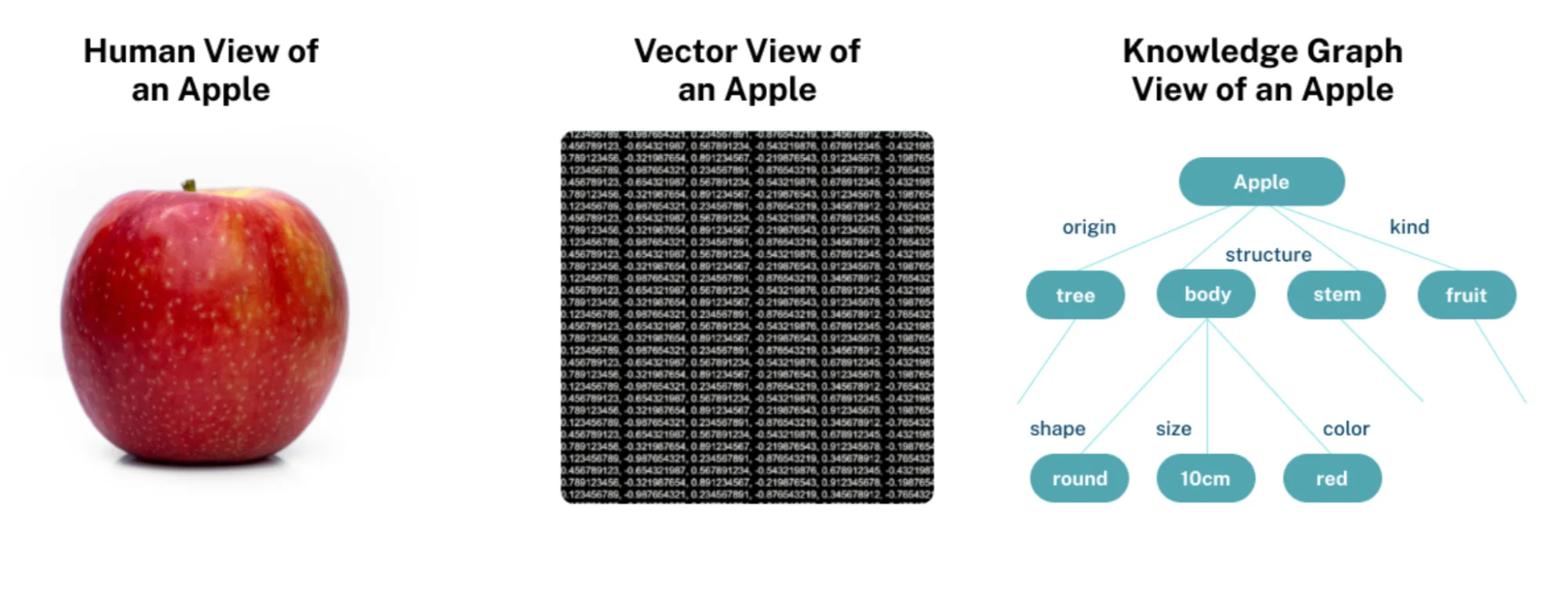
An analogy of how each retrieval method functions. Source: Neo4j
That difference produces different failure modes, which is where the comparison gets practical.
- RAG breaks when vector similarity matches words rather than meaning. If a user asks, “How did Jaguar perform in Q3?” A vector database, seeing the words “Jaguar,” “perform,” and “Q3,” is likely to retrieve documents about the animal (hunting performance), the car company (financial performance), and even the legacy Apple OS (system performance). For a naive RAG system, you get unrelated facts in a nonsensical, hallucinated answer.
- RAG breaks when it comes to holistic questions. A vector store cannot “zoom out.” For example, when asked “what are the top three recurring themes in this entire dataset,” vector RAG would struggle. It searches for the word themes and finds random chunks.
- A knowledge graph only works if someone defines its structure. This is why the “let LLM extract it” shortcut produces noise. A graph is only as good as the schema behind it, and curating that schema is the hard part.
- Knowledge graphs also break down due to maintenance issues. Ontologies drift. Entities get renamed, relationships get added, and without ownership, the graph goes stale faster than chunks do.
In a nutshell, RAG retrieves text by similarity and is cheap and fast but blind to relationships and ambiguity. A knowledge graph is retrieved by traversing explicit relationships and is auditable and multi-hop capable, but expensive to build and maintain.
Which matters more depends on the shape of the question your agent actually faces.
How RAG works
Permalink to “How RAG works”RAG grounds a language model by retrieving relevant text and injecting it into the prompt at inference. The pipeline is well understood: chunk documents, embed each chunk into a vector, store the vectors, retrieve the top-k nearest neighbors at query time, and pass them to the model.
The chunking step is where quality is won or lost.
Alex Albert from Anthropic, in a November 2024 webinar with Pinecone, explained the core problem: “When you look at a standard rag procedure, you often destroy the context in the process of chunking up your documents for embedding so you might have this document and you take you know 1,24 character chunks and you just extract it right out of the document but that creates this isolation problem.”
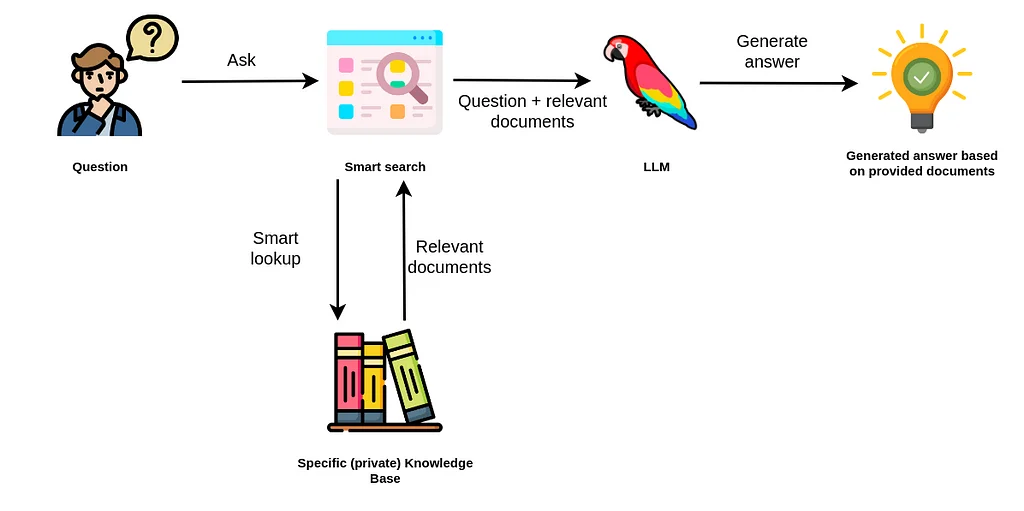
How RAG works. Source: Neo4j
The good news is that RAG can be improved without leaving the architecture.
Lettria’s evaluation with AWS, published December 2024, quantifies the upside of adding graph structure to a RAG workflow. Lettria, an AWS Partner, demonstrated that integrating graph-based structures into RAG workflows improves answer precision by up to 35% over vector-only retrieval methods across four sectors (finance, healthcare, aeronautics, law) and six query categories.
The diagnosis is simple. If your team has not yet tried query reformulation, reranking, or hybrid retrieval techniques, the case for committing to a full knowledge graph is harder to make.
How knowledge graphs work
Permalink to “How knowledge graphs work”A knowledge graph stores entities as nodes and the named relationships between them as edges. Queries traverse paths, which makes multi-hop reasoning native rather than accidental.
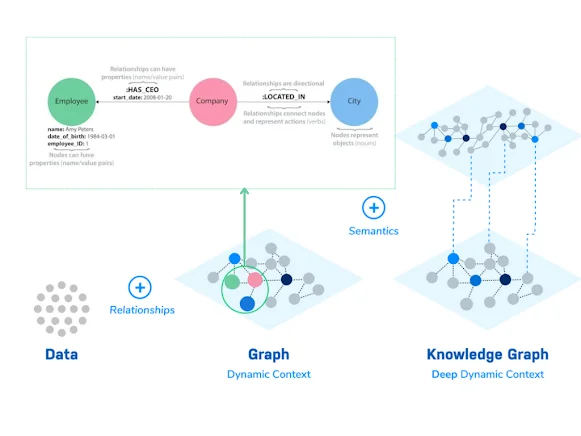
The structure of a knowledge graph. Source: Neo4j
Mitesh Patel, Senior Solutions Architect at NVIDIA, made the multi-hop case directly in his 2025 AIE talk: “If you do a very flat retrieval, which is a single hop, you are missing the most important piece that the graph allows you, which is exploitation through multiple nodes that you can think about and that becomes very important.”
The other advantage is explainability. A vector match is a number; a graph path is a sentence a human can read. For regulated domains, that difference is the whole point.
Knowledge graphs and RAG: How they combine
Permalink to “Knowledge graphs and RAG: How they combine”GraphRAG is the umbrella term for retrieval patterns that combine graph traversal with vector retrieval.
Emil Eifrem, Co-founder of Neo4j, gave the cleanest definition in his AI Engineer Summit 2024 keynote: “GraphRAG is RAG where on the retrieval path you use a Knowledge Graph. It doesn’t say you only use a Knowledge Graph, but you use a Knowledge Graph, maybe in combination with other Technologies like vector search.”
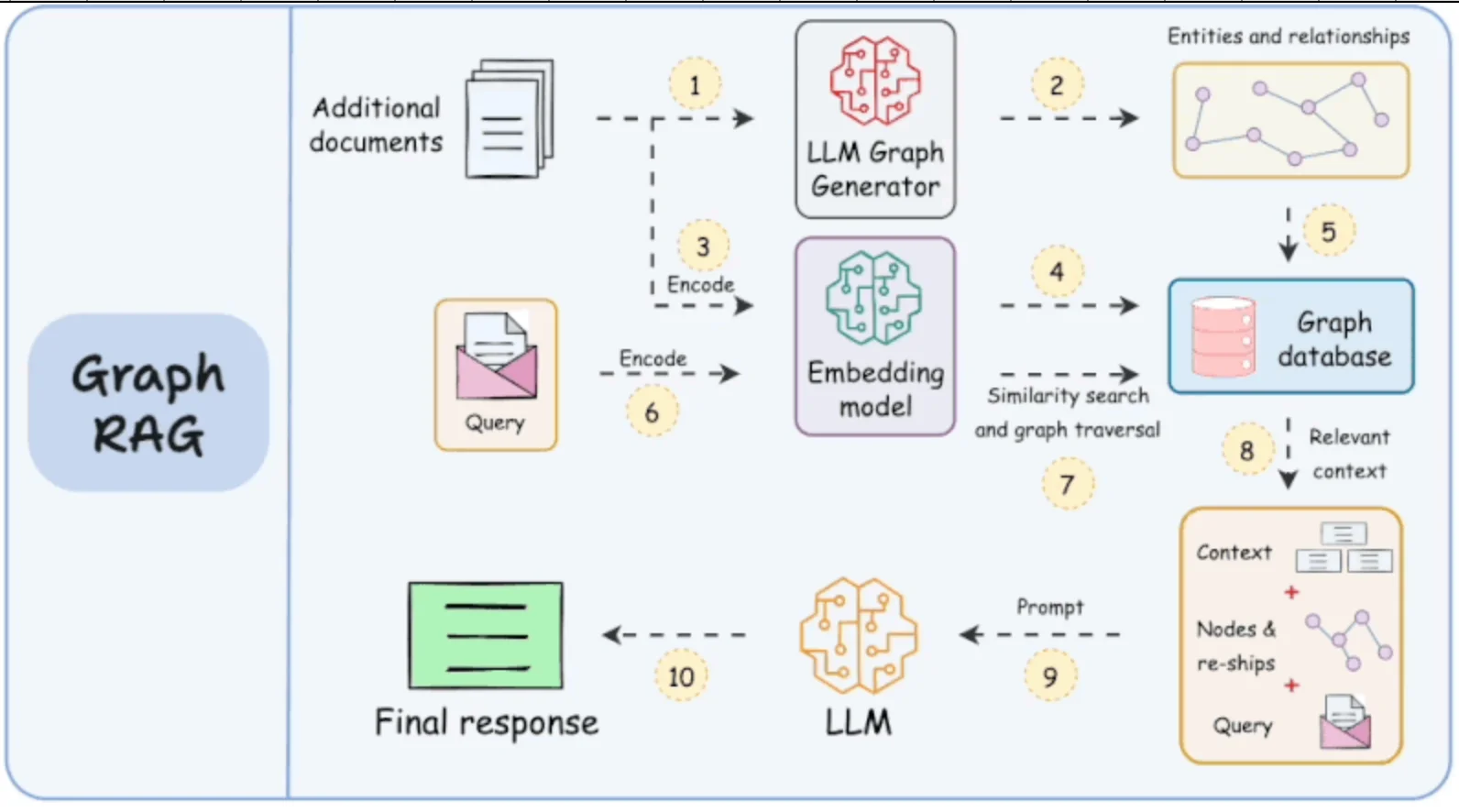
GraphRAG architecture overview. Source: Digital Ocean
GraphRAG offers a highly efficient method for the iterative question answering that characterizes sensemaking activity, while retaining advantages in comprehensiveness (72% win rate) and diversity (62% win rate) over vector RAG. It also requires 97% fewer tokens to produce root-level community summaries than source-text summarization for the same query class.
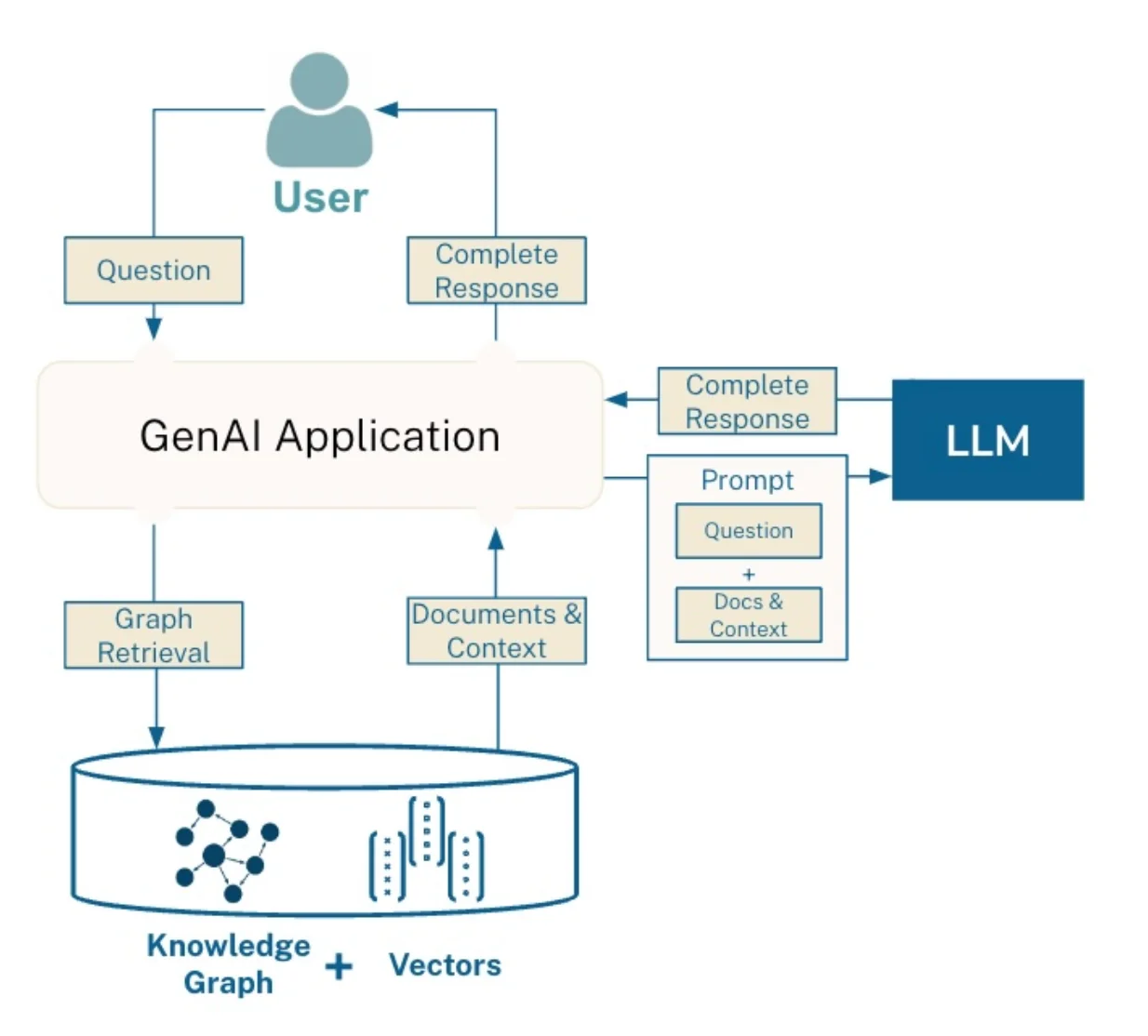
How GraphRAG works. Source: Neo4j
However, pure vector RAG wins on the single-hop, document-centric questions. GraphRAG adds cost without adding accuracy.
It seems not everyone is sold on GraphRAG as commonly built. Douwe Kiela, co-founder of Contextual AI and a co-inventor of RAG, pushed back in an O’Reilly podcast. He said, “In our experience, it doesn’t make a huge difference if you do GraphRAG the way that the original paper proposes. It’s essentially just data augmentation, right? So basically, saying okay, I’m going to add more chunks to my standard vector database that capture some of the hierarchical information, then I just do standard retrieval. So that’s what people call those graphs, but it’s not really a graph, right?”
His larger point sets up the metadata argument later: “The problem is most people don’t have a decent knowledge graph.”
Knowledge graph vs. RAG: A decision matrix
Permalink to “Knowledge graph vs. RAG: A decision matrix”You came for a recommendation you can defend, not a definition. The matrix below maps the four practical axes against the choice of architecture.
| Query type | Explainability need | Latency tolerance | Cost sensitivity | Recommended architecture |
|---|---|---|---|---|
| Single-hop, document-centric Q&A | Low | Sub-100ms | High | Vector RAG with reranker |
| Single-hop, regulated domain | High (audit trail needed) | Sub-second | Medium | Vector RAG plus active metadata layer for provenance |
| Multi-hop, exploratory | Medium | Seconds OK | Medium | LazyGraphRAG or hybrid GraphRAG |
| Multi-hop, regulated (e.g., supplier risk, compliance) | High | Seconds OK | Low | Full hybrid GraphRAG on governed metadata |
| Global sensemaking (“themes in this corpus”) | Medium | Batch OK | Medium | Microsoft GraphRAG community summaries |
| Cross-domain reasoning (e.g., customer 360) | High | Seconds OK | Low | Hybrid GraphRAG on governed metadata |
To sum up the comparison between RAG vs. knowledge graph, here’s what to choose and when:
Use Pure RAG
Permalink to “Use Pure RAG”When your knowledge base is relatively flat, documents are independent, and queries don’t require understanding complex relationships between entities, prefer RAG.
If you’re building a basic FAQ system, documentation search, or content retrieval where each document stands alone, naive RAG is sufficient and more cost-effective. Start simple, scale to graphs when relationships matter.
- Vector store: Pinecone or Weaviate
- Orchestration: LangChain or LlamaIndex
- Embedding: OpenAI text-embedding-3-large or Cohere embed-v3
- Reranker: Cohere Rerank 3 or a cross-encoder
Why this stack: Cheapest, fastest path to production. With a reranker, single-hop accuracy is competitive with hybrid stacks at a fraction of the cost.
Use a knowledge graph
Permalink to “Use a knowledge graph”When your use case requires understanding complex relationships and then extracting that information for the response, prefer a knowledge graph. Remember, these are compute-heavy systems.
- Graph store: Neo4j (hiring-market default), Memgraph (in-memory, low-latency), or ArangoDB (multi-model)
- Orchestration: LlamaIndex property graph store, or LangGraph for agent-style traversal
- Query language: Cypher or SPARQL
- Ontology curation: Manual, with a steward-owned business glossary
Why this stack: Explicit relationships, deterministic queries, auditable paths. The cost is ontology design and ongoing maintenance.
Use a hybrid GraphRAG on a governed metadata layer
Permalink to “Use a hybrid GraphRAG on a governed metadata layer”When you need both single-hop precision and multi-hop reasoning, you operate in an enterprise environment, and the data has not been governance-cleaned, go with a hybrid GraphRAG on a governed metadata layer.
- Retrieval: Microsoft GraphRAG or LazyGraphRAG for global queries; vector store for single-hop
- Orchestration: LangChain or LlamaIndex
- Governance layer: Active metadata platform supplying lineage, certifications, business glossary, ontology
- Agent surface: MCP server for delivery to Claude, Snowflake Cortex, Databricks Genie, and other endpoints
Why this stack: It accepts that no single retriever wins every query type. The governed metadata layer makes the hybrid retriever trustworthy. The MCP server is how that trust is conveyed to the agent.
For a broader comparison, compare AI memory vs. RAG vs. knowledge graph.
What governance failure looks like in knowledge graphs and RAG
Permalink to “What governance failure looks like in knowledge graphs and RAG”Governance failure looks different for both architectures.
Knowledge graph failure modes
Permalink to “Knowledge graph failure modes”| Failure mode | What it looks like in production |
|---|---|
| Ontology drift | Entity and relationship types proliferate as teams add nodes. Three versions of “part of” coexist in one graph |
| Stale relationships | An “owns” edge between an employee and a project persists six months after the employee leaves |
| Unowned entities | A node appears in queries, but no one is responsible for its definition or accuracy |
| LLM-inferred-ontology explosion | “Let GPT-4 extract entities and edges” produces 17 node types from 5 documents and is unusable without curation |
RAG failure modes
Permalink to “RAG failure modes”| Failure mode | What it looks like in production |
|---|---|
| Ungoverned chunks | The vector store contains every document the team could ingest, with no certification or ownership |
| No provenance | The agent returns an answer; tracing it to a source document, version, or owner takes hours |
| PII leakage | A user query retrieves a chunk containing information they should not have access to |
| Role-bypass | Access controls applied at the source data layer are not inherited at the chunk level |
| Stale embeddings | Underlying documents update: the embeddings do not |
The shared failure is the one that matters most. Both architectures break when the data feeding them is ungoverned, which points entirely upstream of the retriever.
Why do both architectures fail without active metadata?
Permalink to “Why do both architectures fail without active metadata?”Both retrievers are downstream of the metadata feeding them. Neither fixes the upstream problem. You get a production-ready system when you solve the upstream problem.
Four properties define the governed retrieval layer that fixes it:
- Active metadata: The catalog, lineage, usage, and certifications stay in sync with source systems programmatically. When a column is renamed in Snowflake, the metadata layer reflects it within minutes, not quarters.
- Lineage: Every retrieved chunk or entity traces back to a source, an owner, and a timestamp. This is what makes audit trails possible and role-bypass failures preventable.
- Certification: A human or a workflow has marked the asset as trustworthy for the use case. This separates “data exists” from “data is ready.”
- Semantic context: The business glossary, ontology, and term linkages live alongside the technical metadata, so the model knows that “ARR” means annualized recurring revenue in your finance team’s usage, even when another team uses the acronym differently.
The payoff shows up in production. In Atlan AI Labs workshops, customers, including Workday saw a 5x improvement in AI analyst response accuracy once an MCP server delivered that governed context to their agents.
Philip Rathle, CTO at Neo4j, framed the architectural conclusion: “We probably want models to have less knowledge themselves and more meta knowledge, to have a better ability to make decisions.”
The choice of retriever matters less than the quality of the metadata feeding it.
FAQs about knowledge graph vs. RAG
Permalink to “FAQs about knowledge graph vs. RAG”What is the difference between full GraphRAG and LazyGraphRAG?
Permalink to “What is the difference between full GraphRAG and LazyGraphRAG?”Full GraphRAG builds an entity graph and community summaries from a corpus up front, which makes global sensemaking strong but raises indexing cost. LazyGraphRAG skips that upfront build and keeps indexing costs close to plain vector RAG, then expands relationships only when a query needs them. Choose full GraphRAG for recurring global questions, and reach for LazyGraphRAG when cost or exploratory speed matters more.
Which performs better for enterprise AI, RAG or knowledge graphs?
Permalink to “Which performs better for enterprise AI, RAG or knowledge graphs?”The query type decides. For single-hop, document-centric questions, use vector RAG with a reranker. For multi-hop, relationship-traversal, or global sensemaking, reach for GraphRAG. Mixed query types in a regulated environment call for a hybrid GraphRAG on a governed metadata foundation. The decision matrix earlier maps each case.
Is RAG cheaper to implement than a knowledge graph?
Permalink to “Is RAG cheaper to implement than a knowledge graph?”Yes upfront. A vector RAG pipeline can ship in days; a knowledge graph takes weeks to months of ontology design. Total cost depends on the query mix. LazyGraphRAG has identical indexing costs to vector RAG, closing the historical cost gap for hybrid stacks.
What is the cheapest path to multi-hop retrieval?
Permalink to “What is the cheapest path to multi-hop retrieval?”LazyGraphRAG is usually the cheapest path. Its indexing costs sit close to plain vector RAG, yet it still answers multi-hop and global questions, which closes the historical price gap with full GraphRAG. Reserve full GraphRAG for cases where recurring global sensemaking justifies the heavier build.
What infrastructure do I need for GraphRAG?
Permalink to “What infrastructure do I need for GraphRAG?”A graph store (Neo4j, Memgraph, ArangoDB, or FalkorDB), a vector store (Pinecone, Weaviate, or OpenSearch), an orchestrator (LlamaIndex property graph store, LangChain, or LangGraph), and a governance layer (Atlan). The hardest component to underestimate is the metadata layer.
Do I need different tools for knowledge graphs vs RAG?
Permalink to “Do I need different tools for knowledge graphs vs RAG?”Often, yes. Vector stores and graph stores are different products. Some frameworks (LlamaIndex’s property graph store, LangGraph) support both.
How Atlan solves the upstream that feeds the architecture of choice
Permalink to “How Atlan solves the upstream that feeds the architecture of choice”Atlan is the governed metadata layer that sits upstream of both, which is exactly where the architectural decision is actually made.
If the question is “what feeds either retriever,” Atlan’s answer is a context layer that unifies semantics, lineage, governance, ownership, quality, and usage into a living, graph-backed system, then delivers that context to agents through MCP, SQL, APIs, and SDKs.
Four capabilities map to the failure modes covered earlier.
- Business glossary and semantic context: When a vector retriever sees “ARR,” it sees three letters. When an Atlan-fed retriever sees “ARR,” it sees the certified definition, the owning team, the SQL view it maps to, and the lineage upstream. This is what makes the Jaguar disambiguation problem solvable.
- Enterprise Data Graph and column-level lineage: Multi-hop questions about enterprise data require knowing how assets are connected. Atlan’s context graph captures those connections at the metadata level, giving a GraphRAG layer a substrate to read from rather than infer from documents.
- Active metadata and certification workflows: Stale corpora are the silent killer of RAG pipelines. Atlan’s metadata lakehouse keeps the catalog synchronized with source systems, and certification workflows mark which assets are trustworthy for which use cases.
- MCP server and agent delivery: The same governed context serves human users in the catalog and AI agents through the Model Context Protocol. The hybrid retriever, the agent, and the human dashboard all read from a single source of truth.
Before configuring the retrieval architecture, build a governed metadata foundation with Atlan and make the retrieval trustworthy.
