



























Metric definitions don’t drift because teams are careless. They drift because “active user” or “quarterly revenue” gets silently redefined every time a new tool, dashboard, or AI agent needs an answer, with nothing forcing the new definition to reconcile with the last one. Most semantic layer guides treat that as a BI problem: pick a tool, centralize the SQL, done. It isn’t one anymore. A semantic layer scoped to dashboards stops working the moment an AI agent starts querying the same data unsupervised, and that shift, from serving BI tools to serving agents, is the thread running through everything below.
What Is a Semantic Layer? The Cure for "Metric Drift"
What is a semantic layer?
Permalink to “What is a semantic layer?”That governed translation layer sits between raw data storage and the tools people and AI agents use to ask questions of it. It translates technical schemas and column names into shared business terms, so a metric or attribute means the same thing everywhere it is queried, in a dashboard, a SQL client, or an AI agent.
Core functions:
- Centralizes metric and entity definitions across BI tools, SQL clients, and AI agents
- Abstracts complex joins and calculation logic behind a simple, consistent interface
- Enforces governance and access policy at query time, not after the fact
- Gives every downstream consumer, human or AI agent, the same answer to the same question
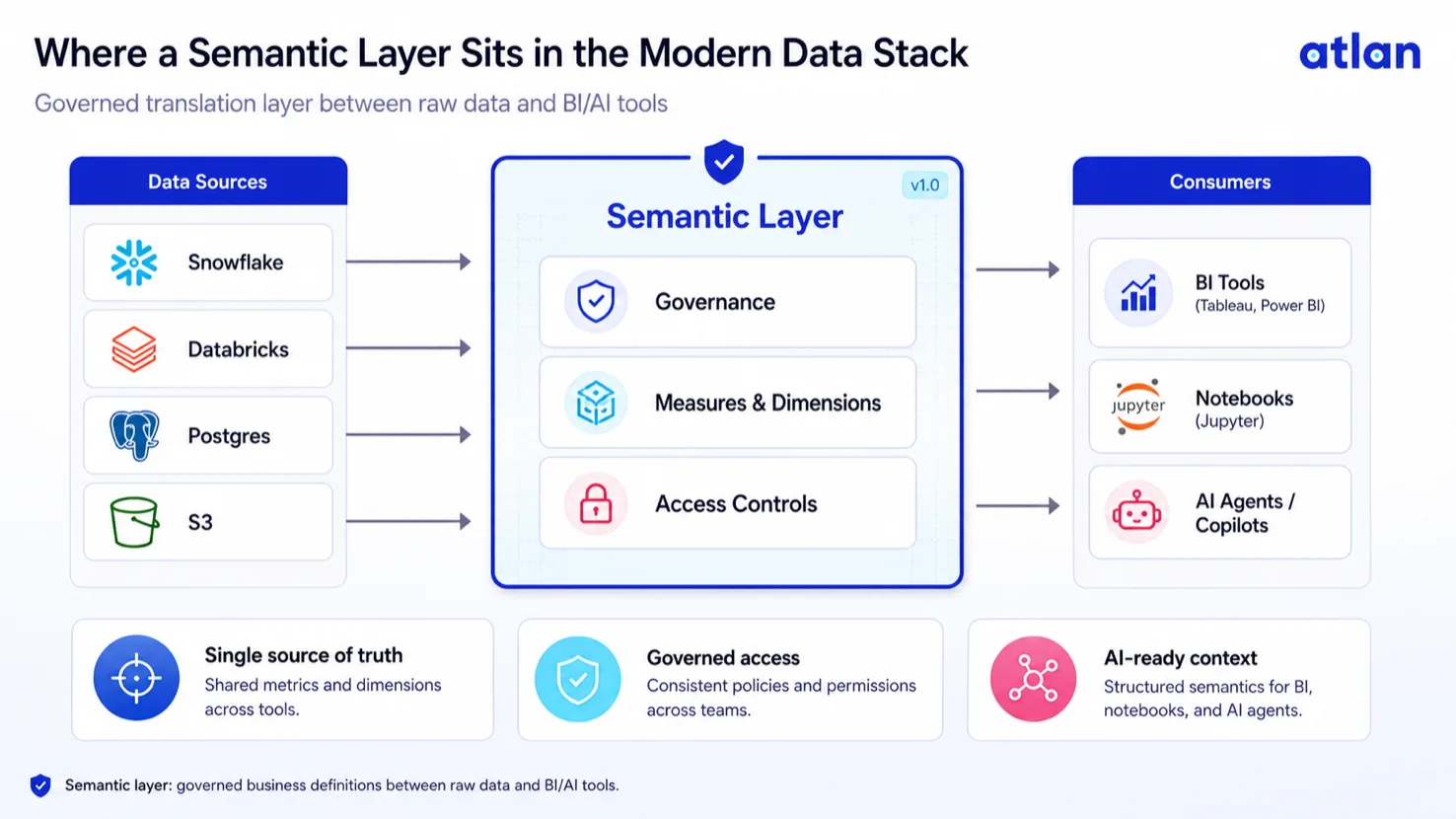
Where a semantic layer sits between raw data sources and BI/AI consumers. Image by Atlan.
Quick facts about semantic layers
Permalink to “Quick facts about semantic layers”| Aspect | Detail |
|---|---|
| Key problem solved | 61% of enterprises use 4+ BI platforms, each maintaining its own metric logic (Forrester) |
| Key benefit | One canonical definition replaces competing versions across teams and tools |
| Implementation start | 5-20 disputed metrics; initial layer in 4-8 weeks |
| AI relevance | Grounds AI agents in approved definitions instead of raw field names |
| Standard | Open Semantic Interchange (OSI), finalized January 2026 |
How does a semantic layer work?
Permalink to “How does a semantic layer work?”A semantic layer intercepts queries between data stores and analytics tools and translates technical field names into governed business definitions. When an analyst queries “Monthly Active Users,” the semantic layer resolves that to the agreed SQL logic, regardless of which BI tool or AI agent issued the request.
Think of it as a translation service that runs automatically. Your raw warehouse has a column called mau_cnt_30d_distinct. Your semantic layer knows that column equals “Monthly Active Users, calculated as distinct user IDs with at least one session in the past 30 days.” Every downstream tool (Tableau, Power BI, your AI copilot) sees the same number and the same definition.
Without a semantic layer, every consumer rebuilds that logic from scratch:
SELECT
  DATE_TRUNC('month', s.session_date) AS month,
  COUNT(DISTINCT u.user_id) AS mau
FROM users u
JOIN sessions s ON s.user_id = u.user_id
JOIN accounts a ON a.account_id = u.account_id
WHERE s.session_date >= CURRENT_DATE - INTERVAL '30 days'
  AND a.plan_type NOT IN ('trial', 'internal')
  AND COALESCE(u.is_test_account, false) = false
GROUP BY 1;
With a semantic layer, the same question is one governed lookup, the joins, filters, and exclusions above are defined once and reused by every tool:
SELECT month, mau
FROM semantic_layer.metrics
WHERE metric = 'monthly_active_users';
The translation happens once, centrally, not inside each tool. Without it, every BI tool, every notebook, and every AI agent maintains its own translation logic. When those translations drift, your data team spends days reconciling reports instead of building new ones. Column-level lineage extends the picture: it shows exactly which source fields feed each business definition, so when an upstream column changes, you can trace impact downstream.
Core components of a semantic layer
Permalink to “Core components of a semantic layer”A semantic layer is built from five kinds of building blocks:
- Measures. The quantitative facts you aggregate, revenue, churn, active users, each with one agreed calculation instead of a different formula per tool.
- Dimensions. The qualitative attributes you slice and filter by: time, geography, customer segment, product line.
- Entities. The real-world business objects the layer resolves, customer, account, order, the things measures and dimensions describe.
- Relationships. How entities and underlying tables join beneath the surface, so a query doesn’t need to know the schema to ask the question.
- Hierarchies. Drill-down paths within a dimension, year to quarter to month, or product to product family to category.
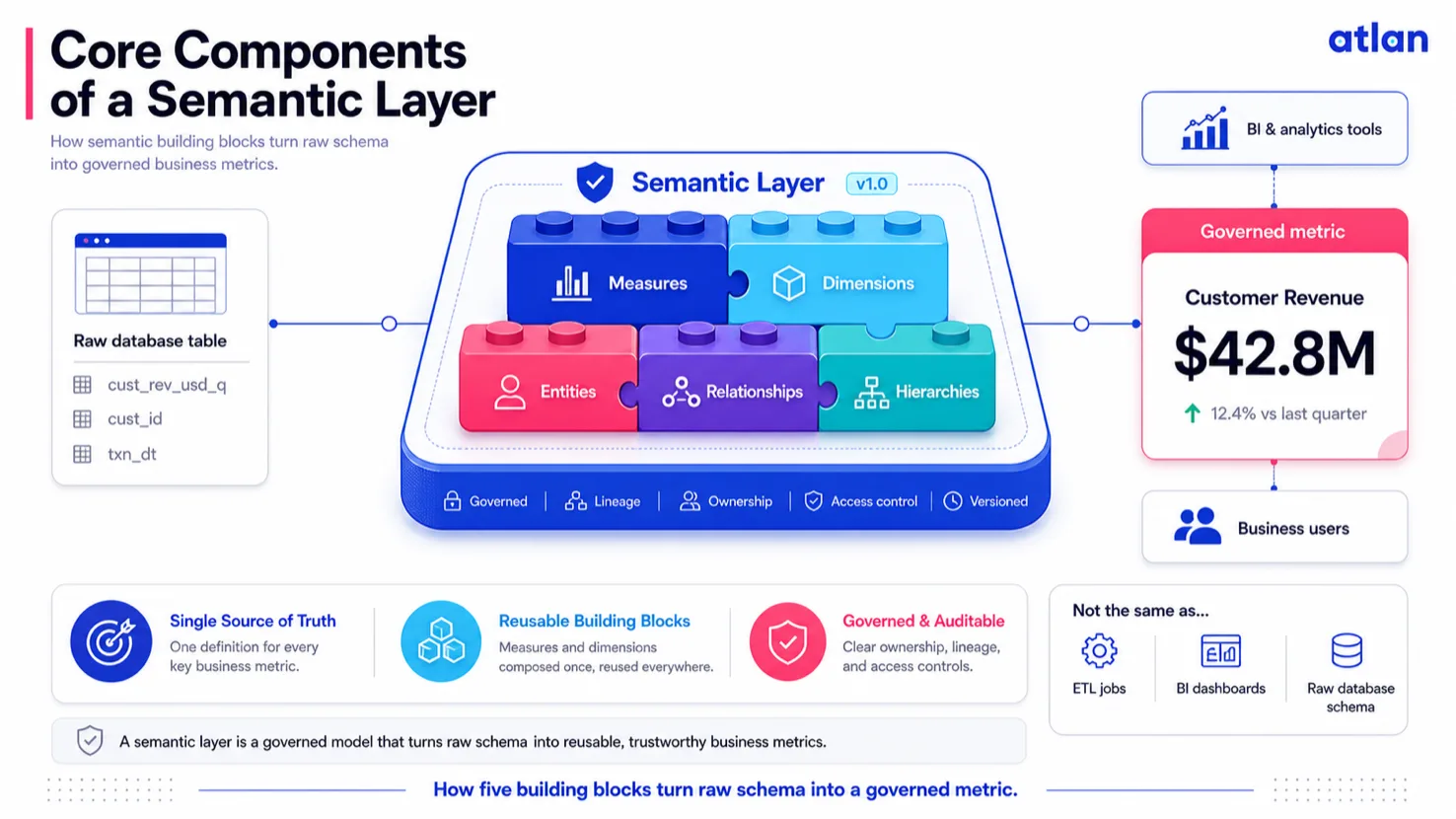
The five building blocks that turn a raw database table into a governed metric. Image by Atlan.
Governance sits on top of all five: access controls determine which values a given user, role, or AI agent is allowed to see, enforced at query time rather than bolted on after the fact.
Performance is not incidental to this either. A semantic layer that recomputes every aggregate from raw rows on every request does not survive production traffic. Universal and active layers typically add a caching layer, materialized views, or precomputed extracts so a governed definition does not mean a full warehouse scan per query; tools like Cube and AtScale build this caching directly into the semantic layer rather than leaving it to the consuming BI tool.
Why do teams need a semantic layer?
Permalink to “Why do teams need a semantic layer?”Metric inconsistency is the core problem. Finance says ARR is $42M. Sales says $44M. Product says $41M. Each number is technically correct by someone’s internal definition, but leadership can’t make a budget decision when the data teams are still arguing about the inputs.
A semantic layer eliminates that argument. It doesn’t just document the agreed definition, it enforces it at query time. Here’s what that unlocks:
- One number, everywhere. Every tool, every user, every AI agent that asks for “Monthly Active Users” or “ARR” routes through the same translation layer and gets the same answer, instead of three slightly different ones.
- A lower cost of bad data. Gartner estimates that poor data quality costs the average enterprise $12.9 million per year, with teams losing 15-20% of revenue to data inefficiencies.
- Less manual reconciliation. Across enterprise deployments analyzed by Atlan, teams with governed semantic definitions see a 53% reduction in time spent reconciling conflicting numbers by hand.
- A foundation for governance. Data governance frameworks depend on this consistency: you cannot govern what you cannot agree on. Metadata management provides the broader discipline; the semantic layer is where that discipline becomes operationally active.
Customer outcomes back this up. Kiran Panja, Managing Director, Cloud and Data Engineering at CME Group, describes it like this:
“With Atlan we cataloged over 18 million assets and 1,300+ glossary terms in our first year, so teams can trust and reuse context across the exchange.”
Why do AI agents need a semantic layer?
Permalink to “Why do AI agents need a semantic layer?”AI agents query data the same way analysts do, and they have no intuition for ambiguous business terms. A semantic layer gives LLM agents grounded, approved definitions to work from. Without it, agents hallucinate metrics or return inconsistent answers. This is why the semantic layer is becoming the context layer for AI in enterprise deployments; see context layer vs. semantic layer for how the two relate.
The cost of getting this wrong is measurable. Gartner predicts that by 2027, organizations prioritizing semantics in AI-ready data will increase GenAI model accuracy by up to 80% and reduce costs by up to 60%. Conversely, Gartner’s March 2026 D&A Summit research projects that by 2028, 60% of agentic analytics projects relying solely on the Model Context Protocol will fail due to the absence of a consistent semantic layer.
| Scenario | Without semantic layer | With semantic layer |
|---|---|---|
| “What is our churn rate?” | Agent guesses from raw fields; may use the wrong date range or customer filter | Agent uses the canonical definition: 1 - (retained_customers / starting_customers) per agreed period |
| “Which customers are enterprise?” | No segmentation rules; agent may include mid-market or use revenue thresholds inconsistently | Classification resolves from business glossary: cust_seg_cd = 'ENT' |
| Cross-system join | Mismatched entity IDs across warehouse and CRM | Canonical entity resolution via governed ID mapping |
| Regulatory reporting | Manual reconciliation before submission | Auditable, policy-enforced definitions with lineage trace |
The emerging standard for exposing semantic layers to AI agents is the Open Semantic Interchange (OSI) specification. Finalized in January 2026, OSI defines a vendor-neutral format for sharing business context (definitions, relationships, and access policies) between semantic layers and AI consumers. Partners include Snowflake, Salesforce, dbt Labs, Atlan, Alation, Mistral AI, and ThoughtSpot.

How a semantic layer grounds AI agents in business logic for accurate, consistent answers. Image by Atlan.
Context Layer ROI Calculator
Put a number on what governed semantic definitions are worth to your team: fewer reconciliation hours, fewer AI-agent errors, faster time to a trusted answer.
Calculate Your ROIThe semantic layer is infrastructure, not a BI feature
Permalink to “The semantic layer is infrastructure, not a BI feature”For most teams, the semantic layer is still a BI concern, something you configure in Looker or dbt to make dashboards consistent. That works until it doesn’t. Every new tool that bypasses the BI layer starts a new metric definition war. Every AI agent that queries the warehouse directly gets a different answer than the one in last quarter’s board report.
The teams moving past this treat the semantic layer as governed infrastructure: explicit ownership, a change-approval process, and an API that AI agents can call the same way BI tools do. “Revenue” in Tableau, in your copilot, in your regulatory submission, in your data scientist’s notebook returns the same number, with the same logic, traceable to the same definition owner.
That shift is already happening at scale. Joe DosSantos, VP, Enterprise Data and Analytics at Workday, frames it this way:
“Atlan captures Workday’s shared language to be leveraged by AI via its MCP server. As part of Atlan’s AI labs, we’re co-building the semantic layer that AI needs.”
A semantic layer built only for dashboards is a BI feature. One built with approved definitions, lineage, and a machine-readable API is AI infrastructure. The scope you design for now determines what you can connect later. That distinction, BI feature versus AI infrastructure, is exactly what separates the four maturity levels below.
The AI Context Stack
A brief on what enterprise AI actually needs beyond a semantic layer: governance, lineage, and access policy, all exposed through a machine-readable interface agents can call.
Get the BriefWhat are the different types of semantic layers?
Permalink to “What are the different types of semantic layers?”Semantic layers vary by where they live in the stack, and the type you choose sets your architecture’s ceiling. Atlan’s Semantic Maturity Model classifies these into four layers: physical, logical, universal, and active. Each step up the ladder broadens the consumer set the layer can serve, from a single warehouse to BI tools to programmatic apps to AI agents.
| Layer | Where it lives | Best for | Key limitation |
|---|---|---|---|
| Physical (in-database) | Inside the warehouse (views, materialized tables) | Simple metric consistency in a single platform | Tied to one platform; breaks across tools |
| Logical (BI-embedded) | BI platform (Looker LookML, Tableau data model) | Team-level definitions inside one BI tool | Locked to that tool; siloed from other consumers |
| Universal (cross-tool) | Standalone middleware (AtScale, Cube) | Multi-tool consistency without rewriting SQL | No governance or lineage built in |
| Active (metadata-governed) | Metadata platform (Atlan) | Full-stack consistency + AI agent grounding | Requires investment in a catalog platform |
Forrester analyst Boris Evelson found that 61% of organizations use four or more BI platforms, with 25% using ten or more. That multi-tool reality is why BI-embedded layers hit a ceiling fast. A physical layer in Snowflake works until your team adopts a second BI tool. A logical layer in Looker breaks down when engineers query the warehouse from Python notebooks. Only a universal or active layer survives a modern multi-tool, multi-persona environment.
For teams running data fabric or data mesh architectures, an active semantic layer is often the practical enforcement mechanism that makes distributed ownership consistent in practice. Active metadata is what separates a static definition repository from a layer that stays current; when metadata is active, definition changes propagate automatically rather than waiting for a manual update cycle.
How does a semantic layer compare to related concepts?
Permalink to “How does a semantic layer compare to related concepts?”A semantic layer is often confused with adjacent tools. Each solves a different problem. The semantic layer translates data into business terms. The data catalog documents what data exists and where. The metrics layer defines calculation logic.
| Concept | Primary function | Who maintains it | AI-ready? |
|---|---|---|---|
| Semantic layer | Translates data to business terms | Data + analytics teams | Yes: definitions serve as grounding context for agents |
| Data catalog | Documents what data exists, where it lives, and who owns it | Data governance team | Partial: provides inventory and lineage, not business definitions |
| Metrics layer | Defines calculation logic for KPIs (formulas, filters, time grains) | Analytics engineers | Yes: metric formulas can be consumed by AI agents |
| Ontology | Classifies concepts and relationships in a formal taxonomy | Knowledge engineers | Limited: static taxonomies without query-time enforcement |
The most important distinction in practice is between the semantic layer and the metrics layer. A metrics layer (like dbt’s) is a type of semantic layer, but narrower; it focuses on metric calculation logic and skips entity definitions, access policies, and concept relationships. A semantic layer is broader, covering metrics, entities, hierarchies, synonyms, and the governance rules that determine who can change a definition. The business glossary is the human-readable artifact that the semantic layer enforces at query time.
The clearest way to separate a semantic layer from an ontology: a semantic layer answers “how much revenue did we make?”; an ontology answers “what is a customer?” One resolves metrics, the other resolves entities and the relationships between them in a formal taxonomy.
How do you implement a semantic layer?
Permalink to “How do you implement a semantic layer?”Start with the five most-disputed metrics, not a comprehensive taxonomy. Teams that skip straight to connecting tools before auditing and defining find themselves automating the existing confusion rather than replacing it.
| Phase | Key activity | Owner | Success signal |
|---|---|---|---|
| Audit | Identify the 10-20 metrics where definitions conflict most visibly | Data governance | A ranked list of conflicting definitions with business impact |
| Define | Create canonical definitions with agreed logic, filters, and examples | Analytics + domain teams | Business glossary populated for priority metrics |
| Connect | Wire semantic layer to BI tools, notebooks, and data pipelines | Data engineering | Queries from all tools resolve through the semantic layer |
| Govern | Set change-approval workflows and definition ownership | Governance team | No definition changes ship without documented review |
| Activate | Expose approved definitions to AI agents and self-serve users | Platform team | AI agents return answers grounded in approved definitions |
Revenue, churn, active user, and qualified lead are usually the right starting points. Before wiring connections in phase three, confirm your target BI tools support an external semantic layer or API-based definition source; Looker (LookML), Tableau (published data sources), and Power BI (certified datasets) all have integration paths, and tools without native support can often be served via a universal layer with a JDBC/ODBC adapter.
Data governance policies determine whether your layer is durable or fragile; without a defined owner and change process, high-value definitions drift back into inconsistency within months. Teams running data mesh with distributed domain ownership need federated semantic governance: each domain defines its own terms, with a central layer resolving cross-domain conflicts.
A semantic layer adds overhead without proportional value if your team runs a single BI tool against a single data source with fewer than five analysts, or if your metric disputes are political rather than technical; it enforces logic, not organizational alignment.

From audit to activation: the five-phase plan for a governed semantic layer. Image by Atlan.
How does a semantic layer fail?
Permalink to “How does a semantic layer fail?”Most semantic layer projects don’t fail at the technology layer; they fail at the operating-model layer. Four anti-patterns recur often enough to be predictable:
| Anti-pattern | What happens | The fix |
|---|---|---|
| Boil-the-ocean taxonomy | Teams try to define every metric before shipping anything; six months in, nothing is in production and the audit list keeps growing | Twenty trusted definitions shipped beats 500 unvalidated ones modeled |
| No definition owner | A metric exists in the layer but no one is on the hook for it; when upstream data shifts, the definition drifts silently | Every definition needs a named owner, the same way data products get an owner |
| Tool-locked definitions | The “semantic layer” lives only in Looker or only in dbt; the definition forks the moment a second BI tool, notebook, or AI agent enters the stack | Choose a layer type (universal or active) that survives multi-tool reality |
| Confusing the layer with alignment | A semantic layer enforces logic, not organizational consensus; it cannot mediate a real disagreement between Finance and Sales about what “customer” means | Resolve the human disagreement first, then encode the result |
The pattern across all four: treat the semantic layer as code with owners, releases, and reviews, not as documentation that someone will get to.
Semantic layer tools and platforms
Permalink to “Semantic layer tools and platforms”The right tool depends on your stack, team size, and AI readiness; see our category-by-category comparison of the best semantic layer tools for 2026.
| Tool | Type | Best for | Limitation |
|---|---|---|---|
| dbt Semantic Layer (dbt integration) | Transformation-layer metrics, defined in YAML alongside dbt models | Analytics engineering teams already invested in dbt | Metric calculation only; no entity definitions, access governance, or AI-agent APIs |
| Cube and AtScale | “Headless BI,” runs independently of any BI tool and serves metrics via API | Multi-tool consistency without rewriting SQL | No governance or lineage built in |
| Looker / LookML | Logical layer embedded in a BI platform | Team-level definitions inside Looker | A new silo the moment you add a second BI tool |
| Snowflake (integration), Databricks Unity Catalog, Cortex Analyst, BigQuery BI Engine, Databricks AI/BI | Platform-native, embedded in the warehouse | Single-warehouse teams; low setup friction | New silo for multi-tool stacks (61% of enterprises, per Forrester) |
| Atlan | Active metadata platform: column-level lineage, governance policies, and 100+ integrations, not a standalone semantic layer tool | Full-stack consistency + AI-agent grounding across the entire data stack | Requires investing in a catalog platform |
When you define “Monthly Active Users” in Atlan, that definition propagates to consuming tools and lineage shows exactly which source columns feed it. As a named partner in the Open Semantic Interchange (OSI) specification, Atlan exposes semantic context to AI agents through a standard protocol, not custom plumbing rebuilt per agent, what separates a BI-scoped layer from one designed to serve your entire intelligent data stack.
dbt’s semantic layer tells an AI agent what a metric means. It doesn’t tell the agent who owns that metric, whether it’s certified, or whether that specific agent is allowed to see it, and those are exactly the questions that surface once agents start querying data unsupervised. Atlan’s governed context layer answers them on top of the metric logic teams have already built in dbt, adding lineage, ownership, and AI-agent access policies instead of asking anyone to rebuild what already works.
Gartner recognized Atlan as a Leader in the Magic Quadrant for Metadata Management Solutions, 2025, with Atlan scoring above average in all five evaluated use cases. Gartner projects that by 2027, adoption of active metadata practices will increase by more than 75%, according to Gartner’s Market Guide for Active Metadata Management.
AI Agent Context Readiness Checklist
A practical checklist for whether your semantic layer, and everything around it, is actually ready for AI agents to query in production.
Check Your ReadinessFrequently asked questions
Permalink to “Frequently asked questions”1. What is a semantic layer in plain language for a business user?
Permalink to “1. What is a semantic layer in plain language for a business user?”For a business user, a semantic layer is what makes “Quarterly Revenue” mean the same thing in Tableau, in your AI copilot, and in the board deck. You ask for “Quarterly Revenue,” and the system looks up the approved definition (filters, time grain, ownership) instead of guessing from raw column names like cust_rev_usd_q. It turns “ask the data team” into “ask the tool.”
2. What is a semantic layer in AI?
Permalink to “2. What is a semantic layer in AI?”AI agents need business context to query data accurately. Without a semantic layer, an LLM agent sees raw field names like arr_usd_contracted and has to guess what they mean, which leads to hallucinated or inconsistent answers. A semantic layer is a grounding layer: it tells agents what “ARR” means, how to filter for enterprise customers, and which date logic applies.
3. Is a semantic layer the same as a data catalog?
Permalink to “3. Is a semantic layer the same as a data catalog?”No. A semantic layer translates data into business terms at query time. A data catalog documents what data exists, where it lives, who owns it, and how it was produced. The two are complementary: the catalog provides inventory and lineage, while the semantic layer enforces the business logic that makes those assets queryable consistently. Most organizations need both, and the integration between them determines how much manual reconciliation your team avoids.
4. What is an agentic semantic layer?
Permalink to “4. What is an agentic semantic layer?”An agentic semantic layer exposes business logic to AI agents via a programmatic API, not just to BI tools. The Open Semantic Interchange (OSI) specification, finalized in January 2026, provides a vendor-neutral format for this exposure. When a definition changes, an agentic semantic layer propagates that update automatically to every connected agent without requiring custom re-integration per tool.
5. What is the difference between a semantic layer and a metrics layer?
Permalink to “5. What is the difference between a semantic layer and a metrics layer?”A metrics layer is a specific type of semantic layer focused on calculation logic: how to compute a KPI from raw data (filters, time grains, aggregation logic). A semantic layer is broader: it covers metric definitions, but also entity definitions (what is an “enterprise customer”?), hierarchies (product to product family to category), relationships between concepts, and access governance policies. dbt’s Semantic Layer is an example of a well-designed metrics layer; Atlan’s platform is an example of a broader semantic governance layer.
6. How does Atlan relate to the semantic layer?
Permalink to “6. How does Atlan relate to the semantic layer?”Atlan enforces semantic definitions through active metadata, column-level lineage, and governance workflows across 100+ integrations. When a definition changes, that change propagates automatically to connected tools and surfaces in lineage so every downstream consumer stays in sync. As a named OSI partner, Atlan exposes semantic context to AI agents through a standardized interface rather than custom integrations per tool.
7. What is the Open Semantic Interchange (OSI) specification?
Permalink to “7. What is the Open Semantic Interchange (OSI) specification?”The Open Semantic Interchange specification is a vendor-neutral standard that defines how semantic layers share business definitions, relationships, and access policies with AI agents and other data consumers. Finalized in January 2026, OSI means an agent built on one platform can consume semantic context from another without custom integration work. Partners include Snowflake, Salesforce, dbt Labs, Atlan, Alation, Mistral AI, and ThoughtSpot. For teams evaluating how semantic layers connect to AI infrastructure, OSI is the emerging interoperability baseline, similar to what JSON-LD became for knowledge graphs.
8. How does a semantic layer work in multi-agent (A2A) systems?
Permalink to “8. How does a semantic layer work in multi-agent (A2A) systems?”In agent-to-agent (A2A) workflows, where one AI agent delegates sub-tasks to specialized agents, each agent in the chain needs access to the same semantic definitions. Without shared grounding, sub-agents return results using different metric logic than the orchestrator expects. The A2A protocol (Google, April 2025) defines how agents communicate task requirements; semantic layers that expose definitions via standardized APIs (including OSI-compliant interfaces) integrate naturally into A2A architectures so every agent in the chain resolves metrics consistently.
9. How does a semantic layer reduce AI hallucinations?
Permalink to “9. How does a semantic layer reduce AI hallucinations?”A semantic layer reduces AI hallucinations by replacing guesswork with governed definitions at query time. When an LLM agent encounters a raw field like cust_seg_cd, it has no way to infer the business meaning. A semantic layer resolves that ambiguity before the agent reasons over the data, mapping cust_seg_cd = 'ENT' to “enterprise customer” with an approved definition, filter logic, and date range. The translation is deterministic, not probabilistic. Without this layer, agents confidently return wrong answers because they fill gaps with pattern-matched assumptions rather than canonical business logic.
10. What is semantic drift and how do you prevent it?
Permalink to “10. What is semantic drift and how do you prevent it?”Semantic drift occurs when a metric’s business rules change (through reorganizations, new product lines, or regulatory updates) but the semantic layer definition isn’t updated to match. The definition that was accurate at deployment quietly starts returning wrong answers with no visible error signal. Prevention requires a named owner for each metric and change-approval workflows that trigger automatically when upstream dbt models or data sources change.
Sources
Permalink to “Sources”- Data Quality: Why It Matters and How to Achieve It. Gartner. https://www.gartner.com/en/data-analytics/topics/data-quality
- Gartner Announces the Top Data & Analytics Predictions. Gartner, June 2025. https://www.gartner.com/en/newsroom/press-releases/2025-06-17-gartner-announces-top-data-and-analytics-predictions
- Gartner Announces Top Predictions for Data and Analytics in 2026. Gartner, March 2026. https://www.gartner.com/en/newsroom/press-releases/2026-03-11-gartner-announces-top-predictions-for-data-and-analytics-in-2026
- Market Guide for Active Metadata Management. Gartner. https://www.gartner.com/en/documents/4004082
- The BI Fabric Baby Is Slowly But Surely Growing Up. Forrester (Boris Evelson). https://www.forrester.com/blogs/the-bi-fabric-baby-is-slowly-but-surely-growing-up/
- Open Semantic Interchange (OSI) Specification. https://open-semantic-interchange.org/
- Model Context Protocol. Anthropic. https://modelcontextprotocol.io/
- Announcing the Agent2Agent Protocol (A2A). Google Developers Blog, April 2025. https://developers.googleblog.com/en/a2a-a-new-era-of-agent-interoperability/
Atlan’s Semantic Maturity Model (physical, logical, universal, active) tells you where your stack is today. Active is where AI-ready teams are heading: explicit ownership, a change-approval process, and an API that AI agents call the same way BI tools do. “Revenue” in Tableau, in your copilot, in your regulatory submission, in your data scientist’s notebook returns the same number, with the same logic, traceable to the same definition owner. That’s not a BI feature. That’s the foundation.
